In-hospital cardiac arrest may be considered different from out of hospital cardiac arrest in that the patient's environment may allow earlier delivery of advanced life support measures, including medications.
Althought the use of sodium bicarbonate is not advised in guidelines, in out of hospital cardiac arrest, it is often given in in-hospital cardiac arrests. The aim, when using bicarbonate is to mitigate the detrimental effects of acidosis, which accompanies cardiac arrest.
THE STUDY
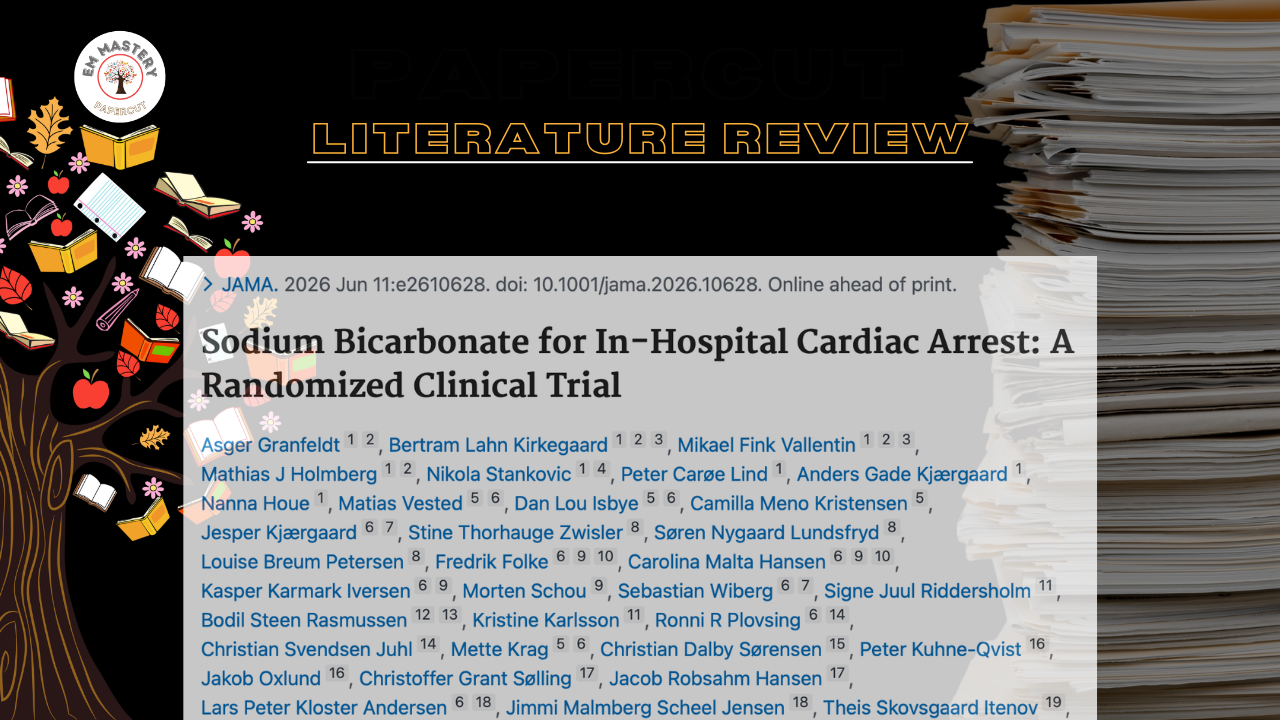
Granfeldt, A plus Bicarbonate for In-Hospital Cardiac Arrest (BIHCA) Investigators. Sodium Bicarbonate for In-Hospital Cardiac Arrest. A Randomised Trial. JAMA 2026 Jun 11:e2610628. doi: 10.1001/jama.2026.10628. Online ahead of print.
WHAT THEY DID
This was an investigator-initiated, randomized, parallel-group, double-blind, placebo-controlled superiority trial, conducted in 21 hospitals in Denmark.
N = 779
Inclusion Criteria
- Adult patients(aged≥18years)with in-hospital cardiac arrest were included, if they had received at least one dose of adrenaline/epinephrine during the cardiac arrest.
Exclusion criteria
- Patients with do-not-resuscitate order prior to the cardiac arrest,
- Invasive mechanical circulatory support (extracorporeal circulation, left ventricular assist device) at the time of cardiac arrest,
- Known or suspected pregnancy
- known objection by the patient to participate in the trial, or to receiving sodium bicarbonate.
Randomisation was in a 1:1 ratio, to receive placebo(sodium chloride) or 50mL of 8.4% sodium Bicarbonate.
This was given as soon as possible after the first dose of adrenaline/epinephrine. A further dose could be given following the second adrenaline dose.
Primary Outcome
Sustained ROSC for at least 20minutes, with no need for chest compressions.
Secondary Outcomes
30 day survival and 30 day survival with favourable neurological outcome
Potential adverse effects identified were alkalosis, hypernatremia, severe hypocalcemia, hypokalemia, and severely elevated lactate.
WHAT THEY FOUND
Primary outcome: There was no significant difference between the two groups in terms of sustained ROSC:
- 39%(146) patients in sodium bicarbonate group
- 37%(placebo group)
Secondary outcomes:
- There was no significant difference in terms of 30 day survival
- 12%(45) in sodium bicarbonate group and 9.1%(37) in placebo
- There was no significant difference in terms of 30 day survival with good neurological outcome
- 8.1%(30) in the sodium bicarbonate group and 5.4%(22) in the placebo group.
DISCUSSION
This an excellent paper and the first RCT on sodium bicarbonate in in-hospital cardiac arrest. Previous studies are old and mostly observational and deal with OHCA.
The paper deals with patients we would normally see, the elderly and those with mostly non-shockable rhythms. However it only deals with patients in Denmark, I'm not sure this matters.
This trial found no difference in the two groups. It also found no harm in giving sodium bicarbonate. Sodium bicarbonate was given at a median time of 8 minutes. Previously criticism of OHCA studies were that sodium bicarbonate was being given late.
This paper didn't look at patients with:
- hyperkalaemia
- TCA overdose
- Na channel blocker toxicity
- Dialysis patients
This trial does not change my practice. I don't use it in cardiac arrest, even one that has been going for some time. I do use it if I believe the cause may:
- hyperkalaemia
- Na channel blockade
- TCA overdose
It is important, as if I get it wrong, and the patient doesnt have toxicity, or an overdose, or hyperkalaemia, then it did not demonstrate any harm.