Migraine is a common reason for presentation to the ED, yet treatment remains highly variable and in some cases inadequate, with a substantial number of patients being discharged, without being headache free.
This update investigated two questions in acute migraine attacks:
-
Which injectable medications are effective for adults with migraines?
-
Are nerve blocks—including greater occipital, supraorbital and sphenopalatine ganglion blocks—effective?
THE PAPER
Robblee J, et al. 2025 guideline update to acute treatment of migraine for adults in the emergency department: The American Headache Society evidence assessment of parenteral pharmacotherapies. Headache. 2026;66:53–76. doi:10.1111/head.70016.
This is an update of the 2016 American Headache Society guideline.
What they did.
This was a systematic review and evidence-based guideline update.
The update included:
No meta-analysis was performed because studies were too heterogeneous in interventions, comparators, doses and outcome measures.
Studies already included in the 2016 guideline were used in developing the recommendations but excluded from the new-study search.
Study quality was graded using American Academy of Neurology criteria.
Recommendation levels
| Level |
Meaning |
| A |
Must offer—or must not offer |
| B |
Should offer—or should not offer |
| C |
May offer—or may not offer |
| U |
Evidence insufficient to make a recommendation
|
What they found?
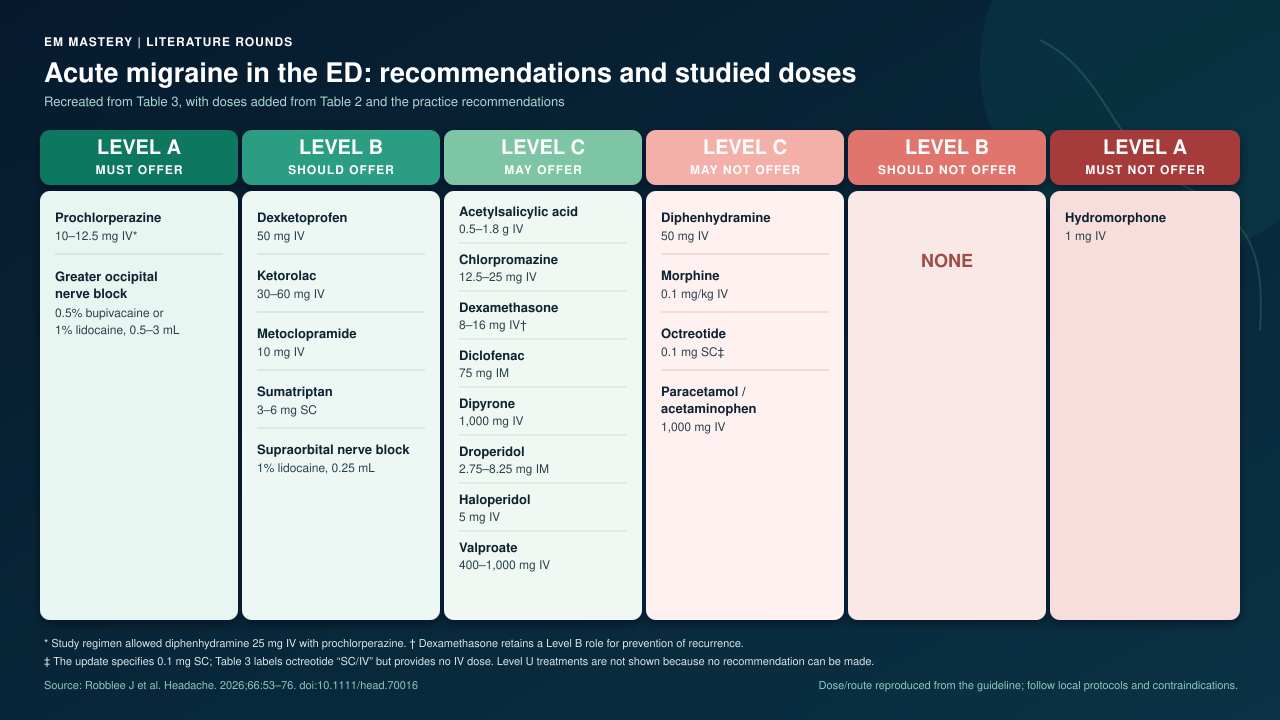
Below is a table summary of findings, with details to follow.
Level A: Treatments that must be offered
IV prochlorperazine Dose: 10–12.5 mg IV
Prochlorperazine was considered highly likely to be effective.
It was:
-
Superior to hydromorphone and sumatriptan
-
Similar to metoclopramide and chlorpromazine
-
Superior to valproate and octreotide in lower-quality studies
Adverse effects include:
-
Akathisia
-
Sedation
-
Postural hypotension
Greater occipital nerve block
Greater occipital nerve block was evaluated in three class I studies and one class II study.
Suggested technique:
The intervention was considered highly likely to be effective. It should be offerred where there are no contraindications, in selected patients and where there is clinician experience. (NOTE: This doesn't mean it must be offerred to all patients above treatment with medications)
Its performance was generally comparable with metoclopramide, although results varied with clinician experience, technique, local anaesthetic and timing of assessment.
This is the major change in the guideline. A greater occipital nerve block is now placed alongside IV prochlorperazine as one of the two treatments with the strongest recommendation.
Level B: treatments that should be offered
Metoclopramide Dose 10 mg IV
Metoclopramide remains a reasonable first-line treatment, although the evidence was less consistent than that supporting prochlorperazine.
One new class I placebo-controlled trial found no significant benefit at 30 minutes. However, the total body of evidence supported efficacy, particularly when metoclopramide was combined with dexketoprofen.
Ketorolac Dose 30-60 mg
Ketorolac was considered likely effective and was upgraded to level B. It performed better than valproate and similarly to metoclopramide
Sumatriptan Dose 3-6mg
SC sumatriptan remains highly likely to be effective but received a level B recommendation, probably because of its contraindications and limitations in the ED population.
It is most appropriate when:
-
The diagnosis is secure
-
The attack resembles the patient’s usual migraine
-
There is no significant cardiovascular contraindication
-
A triptan has not already failed during the attack
Level C: treatments that may be offered
The guideline says the following treatments may be considered:
These are not necessarily equivalent. Some have limited evidence, significant adverse effects or restricted availability.
Dexamethasone Dose: 8–16 mg IV.
Although it may provide some acute benefit, it is more established in decreasing the frequency of migraine recurrence following discharge. It should be used as an adjunct—not the primary analgesic treatment.
Valproate Dose: 400–1,000 mg IV.
Valproate was only considered possibly effective. It performed worse than ketorolac and prochlorperazine in earlier trials, although doses of at least 800 mg may work better than lower doses.
It is an alternative rather than a preferred first-line agent.
Chlorpromazine Dose 12.5-25mg IV
When prochlorperazine and metoclopramide are not appropriate options.
Droperidol Dose 2.75-8.25mg IM
When prochlorperazine and metoclopramide are not appropriate options.
Haloperidol Dose 5mg IV
When prochlorperazine and metoclopramide are not appropriate options.
Other Treatments included:
Acetylsalicylic Acid Dose 0.5-1.8g IV
Diclofenac Dose 75mg IM
There was no recommendation for oral NSAIDS such as ibuprofen.
What to Avoid
IV hydromorphone: must not be offered
Hydromorphone 1 mg IV was inferior to prochlorperazine in a high-quality randomised trial.
Opioids were associated with:
-
Inferior sustained headache relief
-
Greater use of rescue medication
-
Longer ED stays
-
Increased ED return rates
-
Risk of medication-overuse headache and dependence
This is one of the clearest messages from the paper: routine hydromorphone has no place in the treatment of an uncomplicated migraine attack.
The recommendation specifically addresses migraine treatment. It does not preclude opioids for another concurrent painful condition or an exceptional circumstance.
IV Morphine: may not be offered
Morphine 0.1mg/kg IV should not be offerred unless there are no alternative treatment options and stable prior opioid use.
IV paracetamol: may not be offered
IV paracetamol 1,000 mg was considered likely ineffective.
It performed:
This refers specifically to IV paracetamol. It does not establish that oral paracetamol is ineffective when taken early in a milder migraine attack.
Treatments with insufficient evidence
“Insufficient evidence” does not necessarily mean ineffective. It means the evidence was too limited, inconsistent or poorly applicable to routine ED patients.
Propofol and Ketamine
Despite occasional positive small studies, the evidence was inconsistent.
Propofol was considered likely ineffective overall and has important sedation-related risks. Ketamine had insufficient evidence, particularly for the low-dose bolus regimens used in the ED.
Neither should be part of routine migraine treatment.
IV fluids
Normal saline received no recommendation. Fluids should therefore be used for a clinical indication such as dehydration, vomiting or hypotension—not as an intrinsic migraine treatment.
Sphenopalatine ganglion block
Evidence was limited by:
It remains interesting but cannot yet be recommended routinely.
Eptinezumab
Eptinezumab 100 mg IV was superior to placebo in a high-quality trial, but the population did not represent typical ED migraine patients.
It may be effective in carefully selected patients matching the trial population, but there is currently:
No recommendation could be made for:
-
IV caffeine
-
Dihydroergotamine IV or SC
-
Eptinezumab IV for the general ED population
-
IV granisetron
-
IV ibuprofen
-
IV lidocaine
-
IV magnesium
-
IV normal saline as migraine treatment
-
Sphenopalatine ganglion block
-
Parenteral promethazine
-
Tramadol
-
Several older opioids and ergot preparations
Discussion
This is a comprehensive systematic review, that utilised a standardised risk-of-bias process. What this review adds, is the use of nerve blocks. It was not a conventional pooled meta-analysis.
There were important limitations to this study which included:
- Smaller studies may have received a high evidence classification due to the way the AAN risk of bias tool interprets and treats methodology ie., no penalty for small sample sizes and inconsitent endpoints.
- There was significant heterogeneity amongst the studies in terms of Migraine definition, doses, duration of attack and outcome measures.
- There may be limitations related to availability of some medications eg., IV dexketoprofen.
Summary
Prochlorperazine should be a first-line option
For eligible adults requiring parenteral therapy, IV prochlorperazine has the strongest medication evidence. Where prochlorperazine is unavailable, IV metoclopramide remains reasonable.
Greater Occipital Nerve Blocks
The clearest practice-changing finding is the strong recommendation for greater occipital nerve block. It doesn't mean that every patient should receive one.
-
An alternative when systemic medication is contraindicated
-
An option for patients with prominent occipital pain or tenderness
-
A rescue intervention after incomplete medication response
-
A way of avoiding sedation or systemic adverse effects
Use the following if Prochlorperazine cannot be used
-
Metoclopramide 10 mg IV if prochlorperazine is unsuitable or unavailable
-
Ketorolac 15–30 mg IV where not contraindicated
-
Sumatriptan 6 mg SC in a suitable triptan-naïve attack without cardiovascular contraindications
Dexamethasone remains an adjunct
Its principal value is reducing recurrence rather than achieving immediate pain relief.
Avoid Opioids
The guideline strengthens the argument that opioids—particularly hydromorphone—should not be used routinely for migraine.
Avoid the following
-
Propofol
-
Low-dose ketamine
-
IV magnesium
Do not use IV paracetamol
IV paracetamol is not supported as an effective acute migraine treatment and should not displace better options.