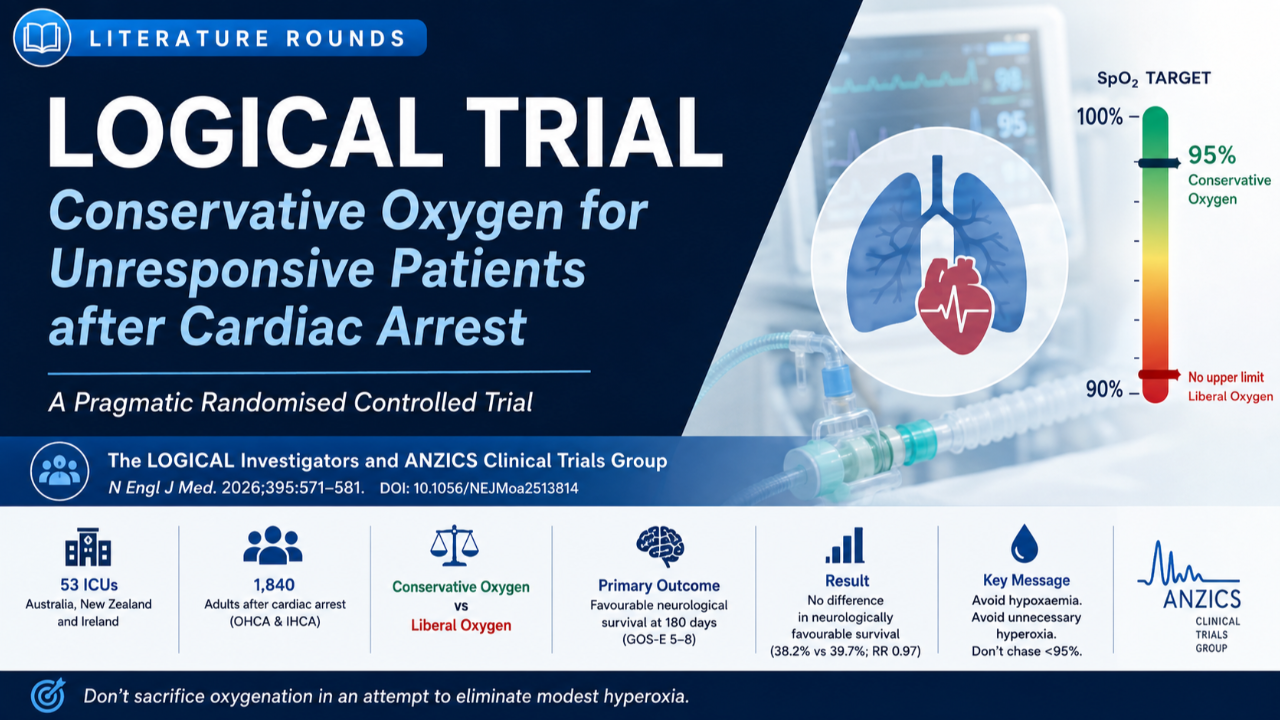
We review the LOGICAL trial, that directly addresses the question of how aggressively we should avoid hyperoxia after ROSC.
THE TRIAL
The LOGICAL Investigators and ANZICS Clinical Trials Group.
Conservative Oxygen for Unresponsive Patients after Cardiac Arrest.
N Engl J Med. 2026;395:571–581. DOI: 10.1056/NEJMoa2513814
The clinical question
In adults who remain unresponsive and mechanically ventilated after cardiac arrest:
Does conservative oxygen therapy, aimed at avoiding hyperoxia, improve neurologically favourable survival compared with a more liberal oxygen strategy?
Hyperoxia after reperfusion may increase oxidative stress and neuronal injury. However low oxygen levels can expose the injured brain to hypoxaemia.
What they did
This was a large, multicentre, investigator-initiated randomised controlled trial conducted across 53 ICUs in Australia, New Zealand and Ireland, that included both OHCA and IHCA.
They enrolled 1,840 adults who were:
-
≥18 years
-
Mechanically ventilated following cardiac arrest
-
Unable to follow verbal commands after ROSC, with suspected ischaemic encephalopathy
-
Randomised within 12 hours of meeting eligibility criteria.
The intervention
The distinction between the two groups is important.
| |
Conservative oxygen |
Liberal oxygen |
| Lower SpO₂ alarm |
90% |
90% |
| Upper SpO₂ limit |
95% |
No upper limit |
| FiO₂ |
Reduce toward 0.21 if oxygenation adequate |
Minimum 0.30 while ventilated |
| Supplemental O₂ after extubation |
Stop if SpO₂ adequate |
Liberal strategy continued |
| Aim |
Minimise hyperoxia |
Avoid deliberate oxygen restriction |
What did they find?
There was clear separation in oxygen exposure between the groups.
They successfully reduced hyperoxia
Median proportion of time with SpO₂ ≥97%:
Conservative: 21.2%
vs
Liberal: 53.0%
Median hours with SpO₂ ≥97%:
16 h vs 37 h
At least one PaO₂ >100 mmHg:
57.7% vs 78.4%
So the intervention did what it was supposed to do: patients receiving conservative therapy experienced substantially less high oxygen exposure.
But there was a trade-off.
More low PaO₂ readings occurred with conservative oxygen
At least one PaO₂ <60 mmHg occurred in:
43.4% conservative vs 27.5% liberal
RR 1.57 (95% CI 1.39–1.78).
Interestingly, however, the median amount of time with SpO₂ <88% was essentially zero in both groups.
This suggests that biochemical episodes of lower PaO₂ were more common without a major increase in prolonged clinically apparent desaturation.
Primary outcome
The primary endpoint was:
Survival with favourable neurological/functional outcome at 180 days
Defined as Extended Glascow Outcome Scale (GOS-E) of 5-8.
Secondary outcomes were:
- all-cause and cause-specific mortality at day 180
- duration of survival to final follow-up
- quality of life and cognition at day 180
- duration of mechanical ventilation
- ICU and hospital length of stay and
- discharge to home.
Results:
Conservative oxygen: 313/819 = 38.2%
Liberal oxygen: 353/890 = 39.7%
RR 0.97 95% CI 0.87–1.09 P = 0.65
Adjusted absolute difference:
−0.9 percentage points 95% CI −5.5 to +3.7
Bottom line
Conservative oxygen did not improve neurologically favourable survival.
If anything, the point estimate numerically favoured liberal oxygen, although clearly this was not statistically significant.
Mortality
Alive at 180 days:
48.0% conservative vs 49.7% liberal
Again, essentially no difference.
The adjusted RR for death was approximately 0.97, with the confidence interval crossing 1.
There was also no convincing difference in:
No adverse events were reported.
Subgroups
One concern is that oxygen might matter most immediately after ROSC, before reperfusion injury has fully developed.
However, the investigators examined patients randomised relatively early versus later.
There was no convincing signal that earlier initiation of conservative oxygen improved outcome.
Similarly, the prespecified subgroup analyses did not identify a convincing group benefiting from conservative therapy.
Discussion
There are two ways of interpreting LOGICAL.
1. Avoiding hyperoxia did not improve outcomes
The conservative strategy clearly reduced oxygen exposure. Yet this did not translate into improved neurological survival.
This weakens the argument that aggressively eliminating relatively modest hyperoxia in the ICU after cardiac arrest produces meaningful neurological benefit.
2. But this does not mean extreme hyperoxia is safe
This is an important distinction.
It was a relatively pragmatic strategy used in this study, with a minimum FiO₂ of 0.30 and no mandated upper SpO₂ target.
Therefore, the study does not demonstrate that severe or prolonged hyperoxaemia is harmless.
It tells us that aggressively titrating oxygen down toward room air to prevent SpO₂ ≥95% does not appear superior to a reasonably liberal oxygen strategy.
An interesting finding: hypoxaemia
For me, one of the more clinically interesting findings is:
PaO₂ <60 mmHg occurred in Conservative: 43.4% vs Liberal: 27.5%
Although these episodes didn't translate into demonstrably worse outcomes, it highlights the potential downside of aggressively pursuing normoxia.
After cardiac arrest, we are caring for an injured brain in which oxygen delivery may already be compromised by:
The theoretical benefit of avoiding modest hyperoxia therefore needs to be balanced against the potentially greater biological danger of hypoxaemia.
Strengths of the trial
This trial was:
-
Large — 1,840 patients
-
Randomised
-
Multicentre: Conducted across 53 ICUs
-
Pragmatic
-
Included both IHCA and OHCA
-
Had relatively few exclusion criteria
-
Used blinded outcome assessors
-
Used a clinically meaningful 180-day neurological endpoint
-
Achieved meaningful separation in oxygen exposure.
Limitations
Timing: Randomisation occurred after ICU admission rather than immediately following ROSC. This may mean that the damage due to hyperoxia, early in the post ROSC period may have occurred before the intervention began.
Treatment separation: There was substantial overlap in oxygen exposure between groups.
Protocol deviations: Approximately 26% of conservative-group patients had deviations involving failure to reduce FiO₂ appropriately.
The trial was open label to treating clinicians. Outcome assessors, however, were blinded.
Finally, the study primarily deals with post-ROSC ICU oxygen management.
Does this change my practice?
LOGICAL provides good evidence that deliberately reducing FiO₂ toward 0.21 simply to prevent SpO₂ ≥95% does not improve neurological outcome.
It does not give us permission for unnecessary FiO₂ 1.0 or marked hyperoxaemia.
A sensible clinical approach remains:
After ROSC: rapidly establish reliable oxygenation → avoid hypoxaemia → once SpO₂/ABG monitoring is reliable, titrate away unnecessary high FiO₂ → but don't aggressively reduce oxygen simply to keep SpO₂ <95%.
The message I take from LOGICAL is therefore:
Avoid hypoxaemia. Avoid unnecessary extreme hyperoxia. But there appears to be little benefit from aggressively pursuing conservative oxygenation after cardiac arrest.
And perhaps most importantly:
Don't sacrifice oxygenation in an attempt to eliminate modest hyperoxia.