Oxygenation and ventilation during CPR is perhaps one of the lesser studied areas in cardiac resuscitation. The use of Bag-Valve-Mask(BVM), is still the most common practice, following reviews that found that intubation confers no benefit over BVM or supraglottic airway (SGA).
The use of continuous oxygen insufflation devices has been promoted as a means of providing continuous CPR, with no interruptions, however the results from these devices have not been encouraging. Here is an in depth discussion of the latest large trial.
THE STUDY
Segond N et al. Neurological outcome of out-of-hospital cardiac arrest patients ventilated with continuous flow insufflation of oxygen: a multicenter observational study. Resuscitation 225 (2026) 111113.
WHAT THEY DID
This study looked at whether continuous flow insufflation of oxygen(CFIO) during CPR was associated with better neurological outcomes than conventional bag-valve-mask ventilation.
It is an observational multicenter cohort study was based on prospectively collected data from the Northern French Alps Emergency Network cardiac arrest registry, between 2017–2021 and used a natural difference in practice between three French EMS regions.
These regions use different methods of oxygenation and ventilation:
- BVM is used in Savoie and Isère.
- CFIO using the Boussignac B-Card, used in Haute-Savoie.
What is the Boussignac B-Card?
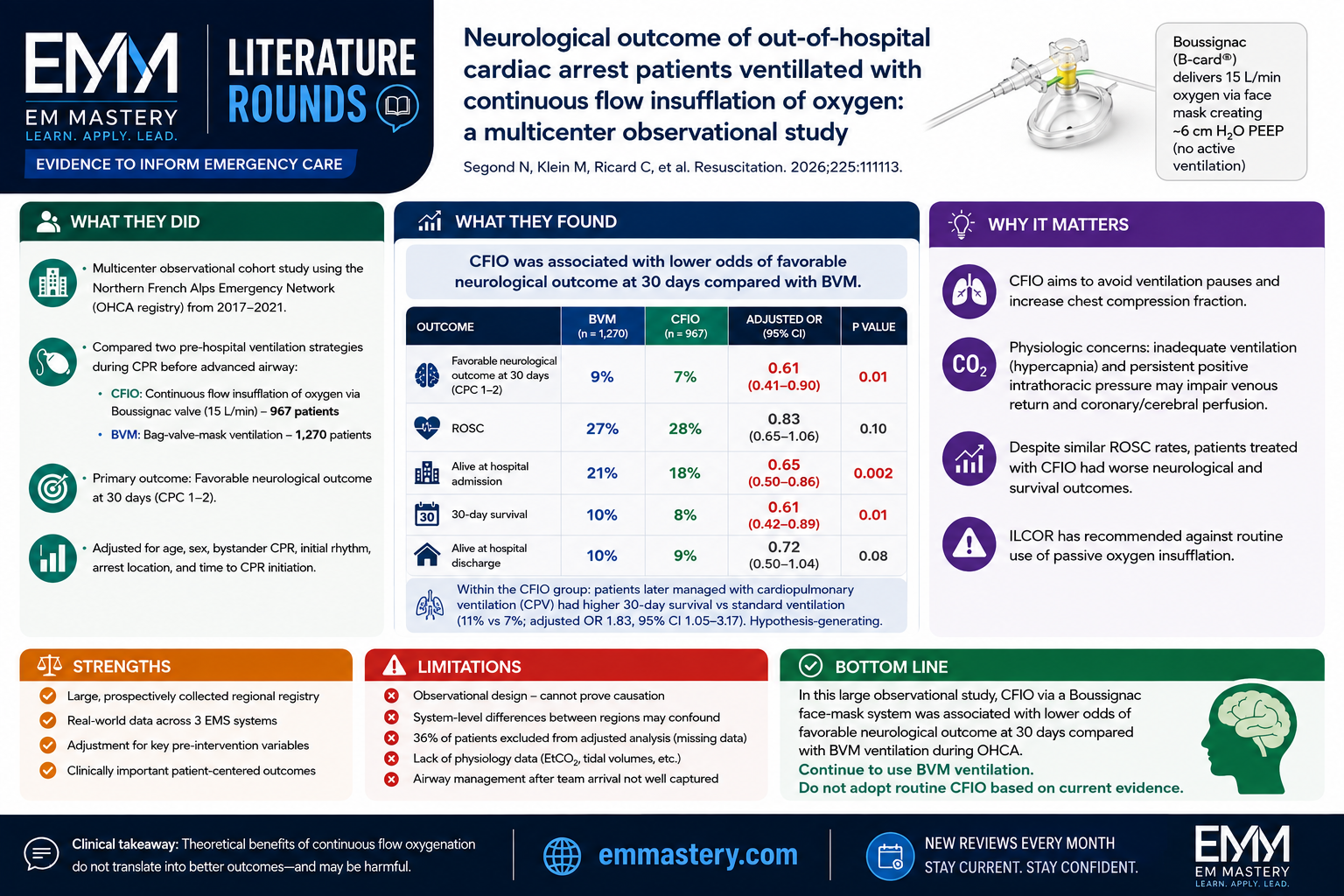
The B-card® (Boussignac valve) is designed to be connected to a face mask, with 15 L/min oxygen flow, generating approximately 6 cm H₂O positive expiratory pressure. No active ventilation is delivered during the initial phase; chest compressions are intended to generate the ventilation.
The study included adults with presumed out of hospital cardiac arrest.
Study outcomes included:
Primary Outcome of 30-day neurological status, using the Cerebral Performance Category (CPC) scale. Favourable outcomes included a scale of 1 and 2, which resulted in independence in daily life with minor of more disability. Unfavourable outcomes included levels 3-5.
Secondary outcomes included ROSC, survival at hospital admission, and 30-day survival.
N=2237 patients with 1270 in the BVM group and 967 in the CFIO group.
WHAT THEY FOUND
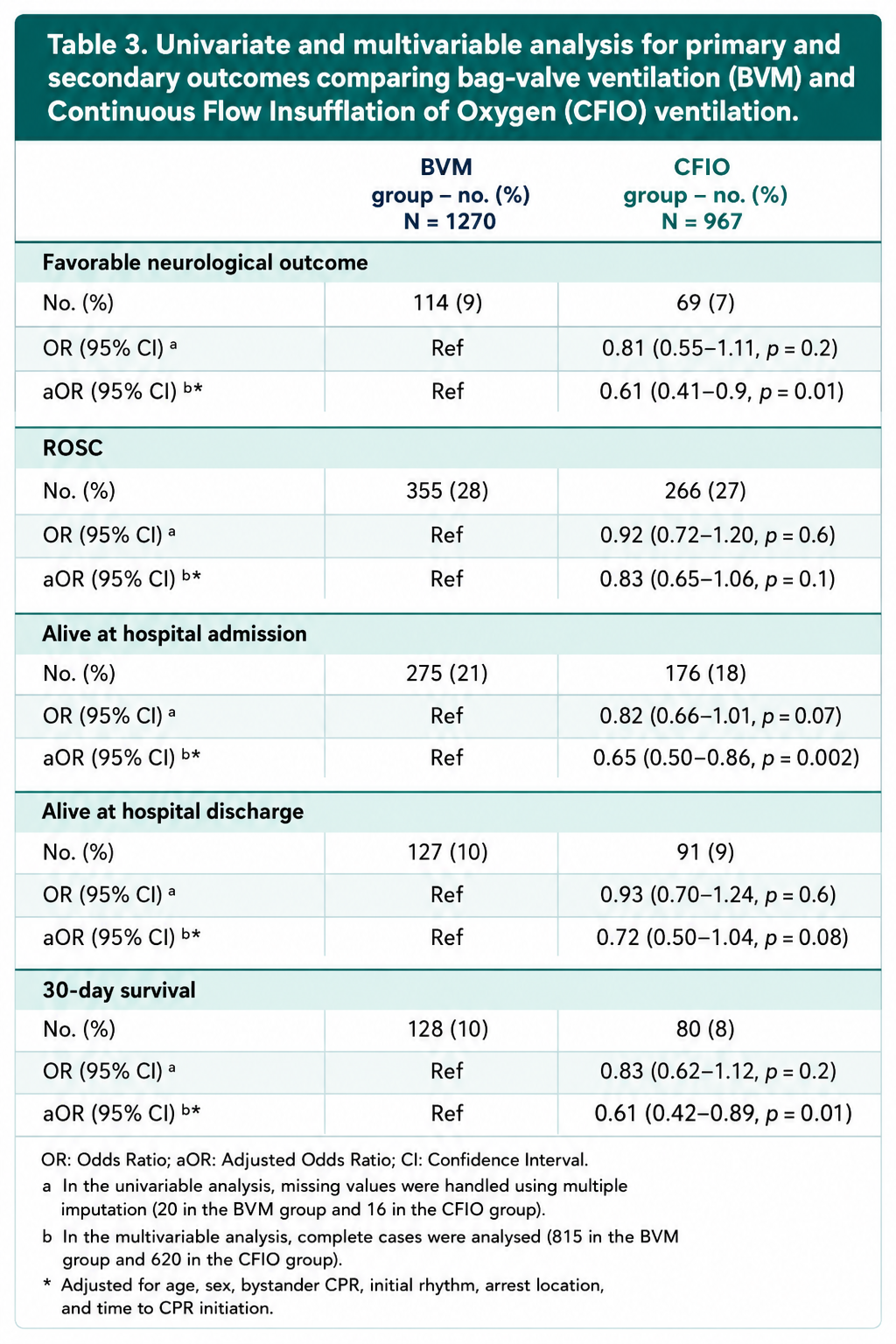
ROSC: The ability to obtain ROSC, was similar for BVM and CFIO
Alive to Hospital Admission: Patients receiving CFIO were less likely to reach hospital alive. BVM 21% vs CFIO 19%. Adjusted OR: 0.65, 95% CI 0.50–0.86; p=0.002
30-day survival: BVM performed better. Adjusted OR 0.61, 95& CI 0.42-0.89
30 day favourable neurological survival: CFIO was associated with a worse survival. Adjusted OR 0.61, 95% CI 0.41-0.90
AN INTERESTING FINDING
The study is more than a comparison of two oxygenation strategies. It is also a study comparing in real time, the changes from one ventilating system to another. Here's what I mean.
In 2017, Haute-Savoie introduced CFIO, replacing BVM. The neighbouring regions retained BVM. Prior to 2017, survival to hospital discharge in Haute-Savoie was 8.3–11%
With a change to CFIO, survival fell to 6.5%. The survival in neighbouring regions using BVM remained stable.
LIMITATIONS AND DISCUSSION
The paper has several limitations.
- It is not an RCT.
- The airway strategy used was not allocated but depended on where the patients lived. This may lead to differences that can't be measured, related to the performance of the EMS providers.
- There were differences between the two groups. The BVM group had
- more males
- more cardiac arrests at home
- more witnessed cardiac arrests
- more bystander CPR and
- more shockable rhythms (although the same number of shocks were delivered in the two groups
- The exact airway procedures were not noted ie., when intubation occurred, was a supraglottic airway used etc..
This study reinforces what we've known in the past, that devices such as this do not work, as much as we would like them to. It is not only a problem of oxygenation. It is also a problem of ventilation. The physiology related to hypercapnoeia and impaired venous return, may be the critical element. Hypercapnoeic cerebral dilatation leading to increased cerebral blood flow and the resultant raised intracranial pressure may have a significant effect on outcomes.
This paper is not a game changer, unless you live in that part of France where the Boussignac device is still used.
SUMMARY