This is a major multidisciplinary PE guideline, covering diagnosis, acute treatment and follow-up.
THE STUDY
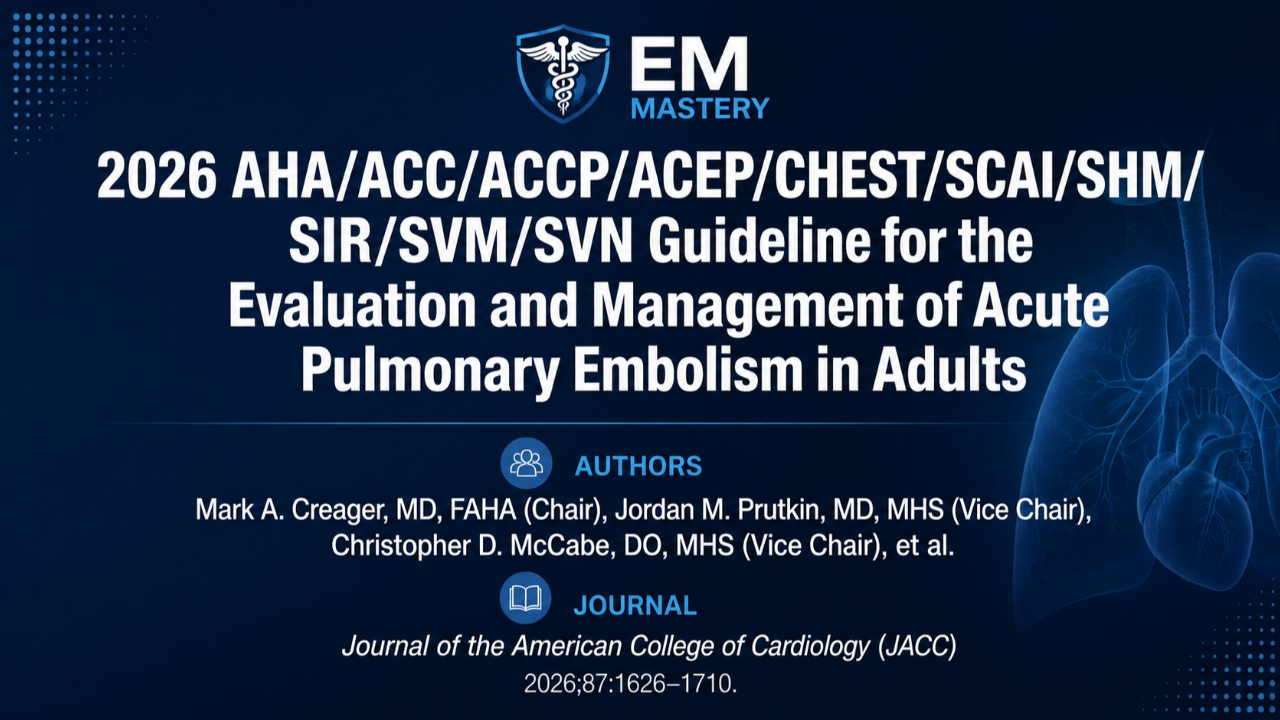
Creager MA, et al. 2026 AHA/ACC/ACCP/ACEP/CHEST/SCAI/SHM/SIR/SVM/SVN Guideline for the Evaluation and Management of Acute Pulmonary Embolism in Adults. JACC. 2026;87:1626–1710. Â
There are three important changes relating to emergency medicine:
1. “Massive/submassive” PE is essentially replaced by a much more clinically useful A–E classification.
2. The guideline identifies the deteriorating but still normotensive patient—Category D—as a group in whom advanced reperfusion should already be considered.
3. Management of the crashing patient is framed as supporting the failing RV while choosing among several reperfusion strategies—not simply “massive PE = thrombolysis.”
Â
1. The major change: AHA/ACC Categories A–E
The guideline explicitly tries to improve on the previous low-risk / submassive / massive terminology and the ESC low/intermediate/high-risk system.
...JOIN US ON LITERATURE ROUNDS, by becoming an EM MASTERY or access with your  EM Lectures membershipÂ
Already registered? Log in here.

This is a major multidisciplinary PE guideline, covering diagnosis, acute treatment and follow-up.
THE STUDY
Creager MA, et al. 2026 AHA/ACC/ACCP/ACEP/CHEST/SCAI/SHM/SIR/SVM/SVN Guideline for the Evaluation and Management of Acute Pulmonary Embolism in Adults. JACC. 2026;87:1626–1710.
There are three important changes relating to emergency medicine:
1. “Massive/submassive” PE is essentially replaced by a much more clinically useful A–E classification.
2. The guideline identifies the deteriorating but still normotensive patient—Category D—as a group in whom advanced reperfusion should already be considered.
3. Management of the crashing patient is framed as supporting the failing RV while choosing among several reperfusion strategies—not simply “massive PE = thrombolysis.”
1. The major change: AHA/ACC Categories A–E
The guideline explicitly tries to improve on the previous low-risk / submassive / massive terminology and the ESC low/intermediate/high-risk system. It integrates clinical state, haemodynamics, respiratory failure, biomarkers and RV dysfunction, and importantly allows patients to move categories as their condition changes.
At its simplest:
| Category | Clinical picture | How I would think about it |
|---|---|---|
| A | Asymptomatic/incidental PE | Subclinical PE |
| B | Symptomatic + low severity score | Low-risk PE |
| C | Symptomatic + elevated severity score | Higher-risk but clinically stable |
| D | Incipient cardiopulmonary failure | Pre-shock / beginning to crash |
| E | Cardiopulmonary failure | Crashing PE |
The guideline itself describes D as including normotensive shock and E as established cardiopulmonary failure. This distinction is significant.
Category D may be the most important new concept in this guideline.
A case:
A 58 year old patient presents to the emergency department within a week of being discharged following total knee replacement. He is dyspnoeic, and has pleuritic chest pain. Clinically the patient has cool peripheries. The patients vitals are: BP 105/70, HR 125, RR 32,
The patient has an elevated lactate of 4 and a raised troponin. A CTPA confirms a large PE and an ECHO shows severe RV dysfunction Should the systolic BP of 105 mm Hg reassure us?
The new system explicitly recognises a patient who has circulatory failure despite retaining a technically “normal” blood pressure.
Previously, patients were dichotomised to:
Normotensive → submassive/intermediate risk vs Hypotensive → massive/high risk.
That is a much better description of the patient we actually worry about in ED; the patient developing cardiogenic shock while maintaining a reasonable systemic blood pressure.
This occurs through:
tachycardia + vasoconstriction + increased sympathetic drive.
Category D describes incipient cardiopulmonary failure: a classification that deliberately tries to identify these “pre-cardiopulmonary failure states.”
The guideline's headline recommendations state that systemic thrombolysis, catheter thrombolysis, mechanical thrombectomy and surgical embolectomy are reasonable for Category E1 and can be considered in D1–D2.
3. Diagnosis
For the stable patient, with low/intermediate clinical probability the guideline supports:
- age-adjusted D-dimer: Age × 10 μg/L FEU in patients >50 years.
- YEARS, using: D-dimer <1,000 μg/L with no YEARS criteria or <500 μg/L with ≥1 YEARS criterion.
CTPA remains the preferred diagnostic imaging test.
Echo is NOT used to diagnose PE and is given a Class III: No Benefit recommendation. ECHO is recommended for haemodynamic/risk assessment, not for making definitive diagnosis. That distinction becomes more nuanced in the peri-arrest patient where immediate management may necessarily be based on the entire clinical picture.
4. RV assessment: Investigations
ECHO
If a patient with PE has an echo, the guideline recommends assessing RV/LV ratio, RV diameter, TAPSE, estimated RV systolic pressure, McConnell sign, tricuspid systolic velocity, paradoxical septal motion and IVC respiratory variation.
CTPA
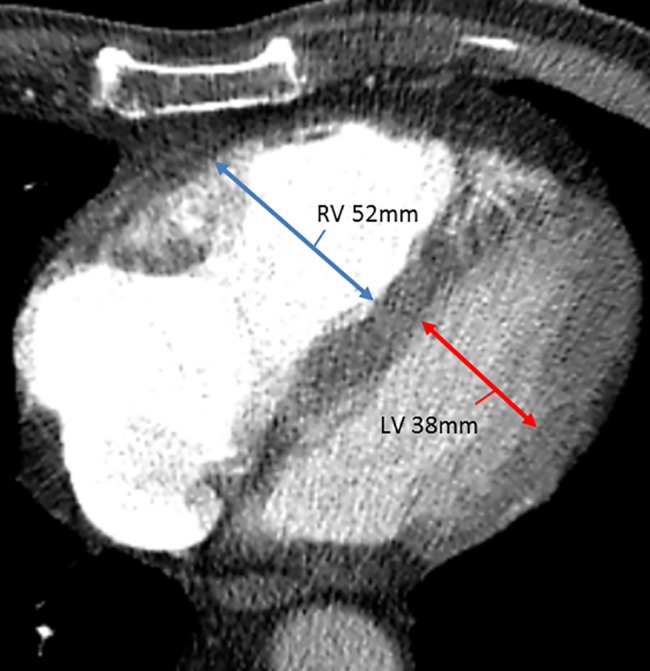
CT should also report a numerical RV/LV ratio, rather than simply saying “RV strain.”
An RV/LV ratio > 1.0 signifies right ventricular dysfunction (RVD) and correlates with a higher risk of adverse short-term outcomes and mortality.

- For Categories A–C, angiographic thrombus burden should not be used for short-term risk stratification.
Treat the patient's physiological response to the PE—not how impressive the clot looks on CT.
5. Anticoagulation
Parenteral Treatment
For patients requiring initial parenteral anticoagulation: LMWH is recommended, as it is associated with reduced recurrent VTE and major bleeding. It is preferred over unfractionated heparin.
This extends to patients likely to undergo endovascular PE procedures and after endovascular treatment or thrombolysis LMWH is preferred for initial parenteral anticoagulation.
Oral treatment
For eligible patients DOACs are preferred over warfarin. Exceptions/special populations include APS, pregnancy, severe renal/hepatic disease and other specific situations.
6. Who can we discharge?
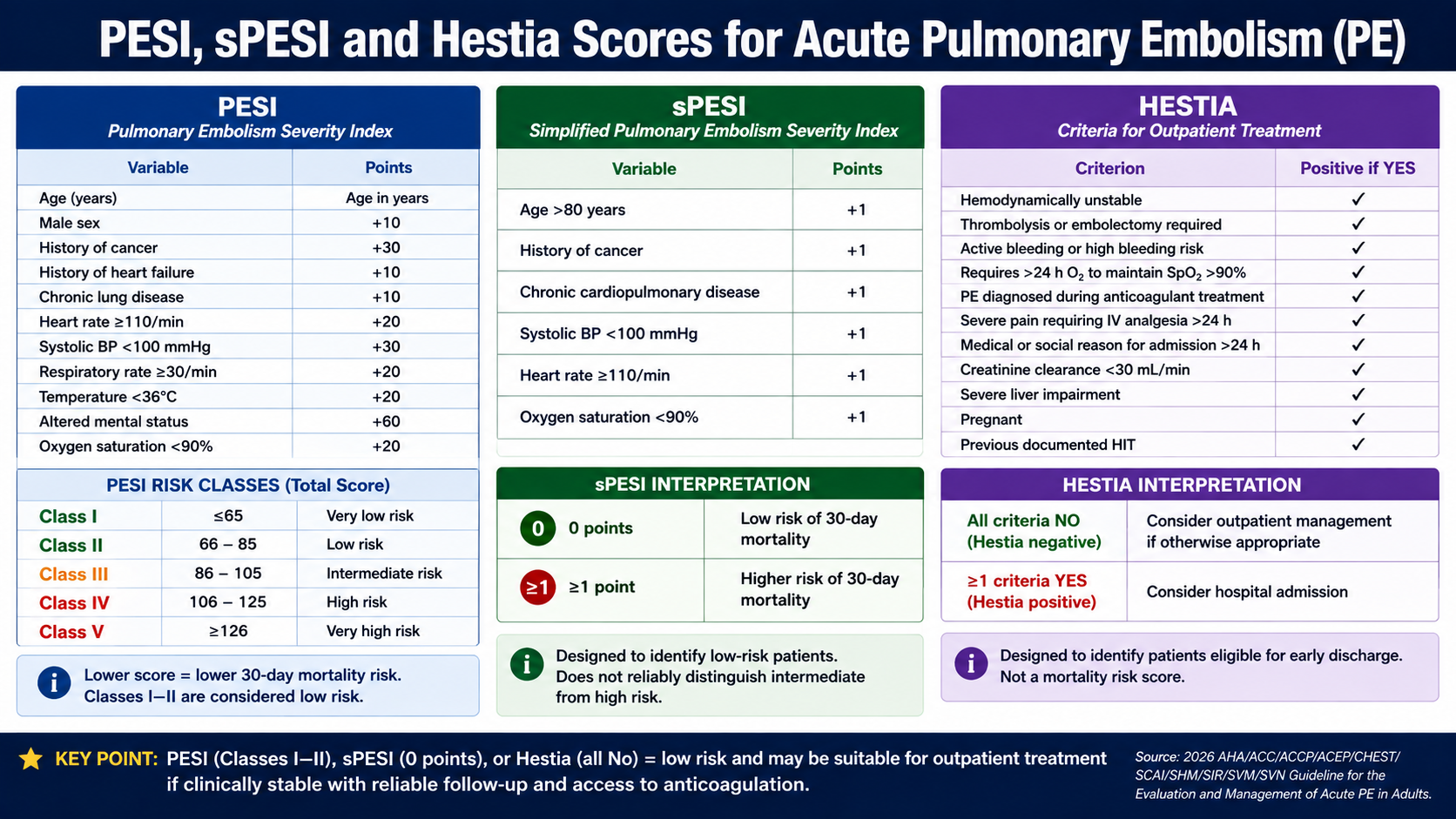
Categories A and B patients are potential outpatient groups provided they have immediate anticoagulant access and reliable rapid follow-up.
The guideline recommends using tools such as: Hestia, PESI or sPESI with clinical judgment.

7. The crashing PE patient
The basic physiology is:
PE → ↑(Pulmonary Vascular Resistance)PVR→ RV pressure overload→ RV dilatation→ septal shift→ ↓ LV filling→ ↓ cardiac output
→ hypotension→ ↓ RV coronary perfusion→ RV ischaemia→ further RV failure.
Our goals are to:
1. Support the RV
and
2. Restore pulmonary blood flow.
8. Fluids: small amounts, if any
The guideline acknowledges that RV failure may be preload-dependent—but it is very cautious, due to the lack of good evidence. If the RV is already dilated, more preload may worsen septal shift and LV filling.
The guideline suggests:
- small boluses ≤500 mL in selected patients
- avoiding larger-volume or indiscriminate fluid loading.
9. Vasopressors: noradrenaline(norepinephrine)
Noradrenaline is the preferred vasopressor. At low doses it ↑ SVR without affecting PVR
The aim isn't simply reaching a particular MAP, we need to restore systemic pressure to improve right ventricular perfusion.
If cardiac output remains low, the guideline recommends dobutamine up to 10 μg/kg/min. This increases cardiac index, however it can also decrease SVR.
Therefore dobutamine may be an adjunct to noradrenaline in hypotensive low-output PE and may be considered in normotensive cardiogenic shock.
10. Pulmonary vasodilators
Another interesting recommendation is that inhaled pulmonary vasodilators may be considered in Categories C2–E. This not something we would use in the emergency department, however it would definitely be used in ICU.
They ↓ PVR → ↓ RV afterload without the systemic hypotension produced by nonselective vasodilators.
The evidence is not definitive. Inhaled nitric oxide did not improve the primary endpoint in one RCT, although post-hoc analysis suggested improved RV size/function.
11. Intubation is high risk
This is one of the strongest messages in the guideline.
It gives: Class III: Harm to unnecessary deep sedation/mechanical ventilation in Categories C–E.
The reason for this are the effects of intubation on the physiology. The patient may be maintaining systemic perfusion through: tachycardia + elevated SVR + sympathetic tone.
Sedation removes these compensatory mechanisms. Then positive-pressure ventilation can impair venous return and alter RV loading.
The guideline specifically warns that anxiolysis/analgesia and particularly intubation sedation can cause catastrophic haemodynamic collapse.
Don't intubate simply because the respiratory rate is high.
If oxygenation can be maintained non-invasively, allow spontaneous ventilation while fixing the PE.
For moderate-severe hypoxaemia, the guideline recommends HFNC preferable to standard nasal oxygen. This becomes a circulatory resuscitation procedure, not merely an airway procedure.
The guideline makes a Class I recommendation that Categories C–E patients requiring intubation should have vasopressors and/or inotropes and/or VA-ECMO capability available in case haemodynamic collapse occurs.
This is a very strong statement given the evidence is limited.
For the crashing PE patient I would think in this way:
pressor → preoxygenate → minimal haemodynamically disruptive sedation → best operator first-pass intubation → cautious positive pressure.
12. Reperfusion: the major change
For patients in Category E1, advanced therapies include.
- Systemic thrombolysis
- Catheter-directed thrombolysis
- Mechanical thrombectomy
- Surgical embolectomy.
They should also be considered in Category D1–D2, making early identification of potential deterioration before hypotension develops an important goal.
13. Mechanical thrombectomy
The document explicitly acknowledges: that there are no randomized trials comparing mechanical thrombectomy with systemic thrombolysis in high-risk PE.
FLAME provides important observational evidence.
The FLAME study
Silver MJ et al.
Outcomes in High-Risk Pulmonary Embolism Patients Undergoing FlowTriever Mechanical Thrombectomy or Other Contemporary Therapies: Results From the FLAME Study. Circ Cardiovasc Interv. 2023.
FLAME is probably the most important contemporary study specifically addressing thrombectomy in high-risk PE.
What they did
This was a prospective multicentre study of 115 patients with haemodynamically unstable high-risk PE.
Patients treated with the FlowTriever large-bore mechanical thrombectomy system were compared against a prespecified performance goal derived from contemporary outcomes in high-risk PE.
This was not a randomized trial.
What they found
Outcomes in patients selected for mechanical thrombectomy were remarkably good relative to historical expectations for this population.
The reported in-hospital mortality in the FlowTriever arm was approximately 1.9%, considerably below the predefined performance threshold and below outcomes among patients treated with other contemporary approaches.
However there was selection bias in this study This wasn't: thrombectomy versus thrombolysis randomized 1:1.Patients able to get into an interventional laboratory and undergo thrombectomy may inherently differ from a patient arriving in profound refractory shock undergoing CPR.
So FLAME tells us:
Mechanical thrombectomy can work extremely well in selected high-risk PE patients.
It does not establish that Mechanical thrombectomy is superior to systemic thrombolysis.
14. Surgical embolectomy
The guideline gives surgical embolectomy a Class IIa recommendation for Category E1 compared with anticoagulation alone.
The guideline reports mortality of approximately 1–15% across modern surgical series, with >97% survival reported among patients who had not required CPR.
However there are no prospective randomized comparisons. These are highly selected observational populations.
The document also acknowledges that superiority of surgery over systemic thrombolysis in D1–E1 is uncertain, although surgery may reduce ICH risk.
15. Which reperfusion therapy?
This guideline doesn't really answer which is best: Thrombolysis vs thrombectomy vs surgery
Perhaps the practical interpretation is:
Reperfuse the crashing patient using the fastest appropriate therapy available at your institution.
For many hospitals this will be systemic thrombolysis.
At centres with an established PE intervention service: mechanical thrombectomy may be extremely attractive.
With contraindication to lysis and immediate surgical capability, embolectomy may be preferable.
16. PERT
The guideline gives PE Response Teams significant prominence. They improve timeliness of care.
This is related to decision making about treatment ie., anticoagulation vs systemic lysis vs catheter lysis vs thrombectomy vs surgery vs ECMO18. Follow-up and anticoagulation duration
The guideline defines:
initial treatment = 3–6 months and extended treatment = >6 months.
For a first PE without a major reversible provoking factor, or with a persistent risk factor, continuing anticoagulation beyond 3–6 months is recommended.
The other important recommendation is follow-up for post-PE disease.
Patients should be asked about: dyspnoea and exercise limitation and other PE-related functional symptoms.
Take Home Points?
1. Don't wait for hypotension recognise Category D: incipient cardiopulmonary failure.
Falling BP, poor perfusion, rising lactate, worsening RV function and escalating respiratory support should trigger early discussion about advanced therapy.
2. Protect the RV.
Avoid indiscriminate fluid loading. Use small boluses only when appropriate and bring norepinephrine in early.
3. Avoid unnecessary intubation.
The guideline goes as far as Class III: Harm for unnecessary deep sedation/mechanical ventilation in Categories C–E.
4. Think “reperfusion,” not just “thrombolysis.”
Systemic lysis, catheter therapy, thrombectomy and surgical embolectomy are now all legitimate advanced options in the right high-risk patient—but there is not yet good evidence proving which is superior.