Hospitalisation of Syncope/pre-syncope patients
Oct 01, 2026Does hospital admission help patients with unexplained syncope?
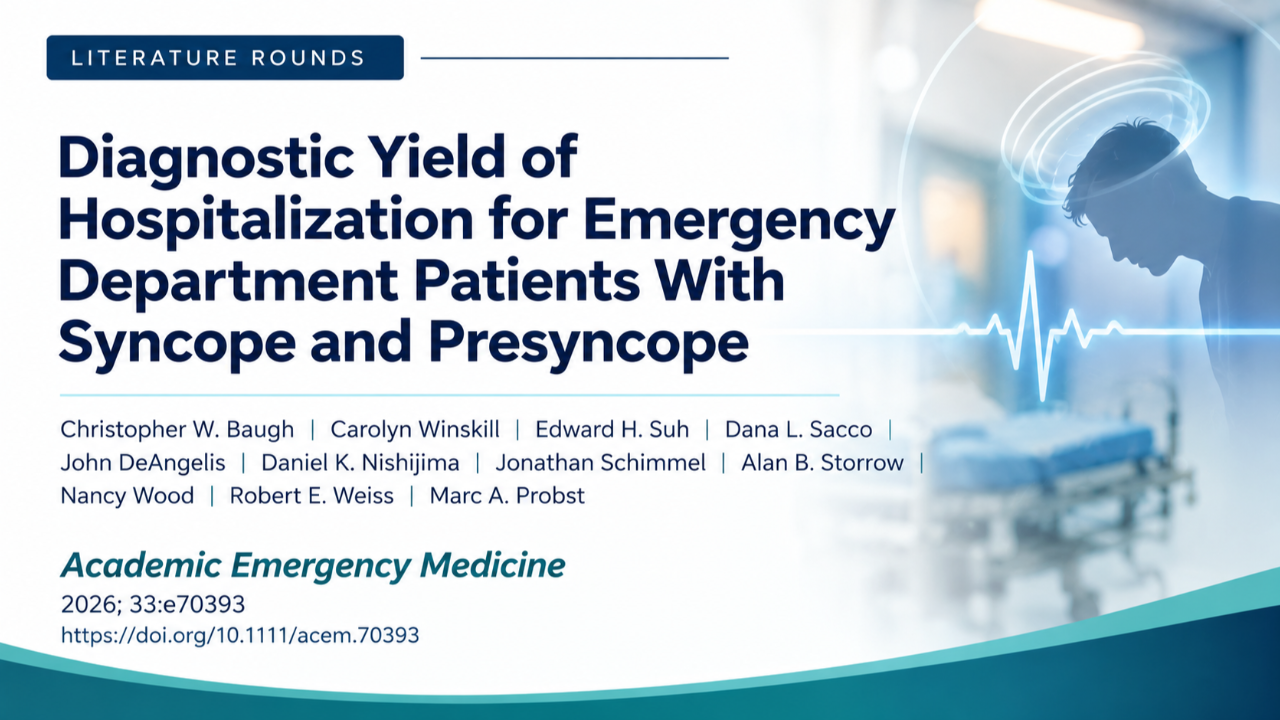
Baugh CW, Winskill C, Suh EH, et al. Diagnostic Yield of Hospitalization for Emergency Department Patients With Syncope and Presyncope. Academic Emergency Medicine. 2026;33:e70393. syncope and admission
The clinical question
We frequently reach the end of an ED syncope assessment without finding a cause. The patient now looks well, but the concern remains: are we going to miss something important if we send them home?
This study question:
In adults ≥40 years with unexplained syncope or presyncope after ED assessment, does hospitalisation increase the detection of serious adverse outcomes compared with discharge?
Study design
This was a planned secondary analysis of a prospective, multicentre observational cohort, conducted across six urban US emergency departments from September 2020 to September 2024.
It is a prospective, multicentre, observational, non-randomised design
Patients were ≥40 years old and presented with either syncope or presyncope. Patients in whom the ED had already diagnosed an important cause—such as significant arrhythmia, MI, PE, aortic dissection, significant haemorrhage, sepsis or intracranial haemorrhage—were excluded. syncope and admission syncope and admission
Population
1,263 patients
- Mean age: 64.8 years
- Hospitalised: 563 (44.6%)
- Discharged: 700 (55.4%)
- Of those hospitalised, about 70% were managed in observation and 30% were admitted.
- Mean hospital stay: 3.6 days. syncope and admission
Definition of serious outcome?
The primary outcome was a serious adverse outcome (SAO) within 30 days, including:
- Death
- Significant arrhythmia
- MI
- Significant structural heart disease
- CPR
- Posterior circulation stroke
- SAH
- PE
- Aortic dissection
- Major haemorrhage requiring transfusion
- Sepsis
- Cardiac intervention
Significant arrhythmias included VT/VF, sick sinus disease, Mobitz II or complete heart block, symptomatic SVT and symptomatic bradycardia. syncope and admission
******For discharged patients, all SAOs occurring within 30 days contributed to diagnostic yield. For hospitalised patients, the primary diagnostic-yield analysis counted an SAO only if it was diagnosed during the index hospitalisation. syncope and admission
What They Found
Hospitalisation found more serious diagnoses.
Overall:
74/1,263 — 5.9% had a serious adverse outcome within 30 days.
62/1,263 — 4.9% had a serious cardiac outcome.
The commonest serious outcome was significant arrhythmia: 37 patients (2.9%), with symptomatic SVT the most frequent arrhythmia. syncope and admission
After propensity-score adjustment:
Hospitalisation → OR 3.70
95% credible interval 1.85–6.82
for detection of a serious adverse outcome compared with discharge. The fully adjusted analysis was almost identical: OR 3.71 (95% CrI 1.95–6.56). syncope and admission
So, even after attempting to account for differences between the two groups, hospitalisation was associated with roughly 3.7 times the odds of detecting a serious outcome.
Hospitalisation also found problems earlier
After propensity-score matching, the hazard ratio for detecting a serious outcome during the hospitalisation period was:
HR 12.43
95% CI 2.94–52.48
Among hospitalised patients who had an SAO detected during the index admission, the mean time to diagnosis was 3.8 days. syncope and admission
What was actually being found?
Among the 74 serious outcomes:
| Outcome | Total |
|---|---|
| Significant arrhythmia | 37 |
| Cardiac intervention | 29 |
| Pacemaker | 14 |
| AICD | 5 |
| MI | 3 |
| PE | 2 |
| Stroke | 1 |
| CPR | 1 |
| Death | 5 |
Of the 37 arrhythmias, 23 were detected during the index admission. Ten of the 14 pacemakers and all five AICDs occurred during the index hospitalisation. syncope and admission
This suggests that much of the diagnostic advantage of hospitalisation may relate to continuous cardiac surveillance detecting intermittent arrhythmias.
And that raises an important question:
Is the intervention we need actually hospitalisation—or is it prolonged rhythm monitoring?
The admitted and discharged patients were very different.
This was not randomised. Clinicians decided whom to admit.-----confounding
They admitted higher risk patients.
For example:
| Characteristic | Discharged | Hospitalised |
|---|---|---|
| Mean age | 61.8 | 68.5 |
| Heart failure | 5.6% | 18.7% |
| CAD | 11.6% | 28.8% |
| Previous arrhythmia | 12.3% | 23.3% |
| Valvular disease | 14.3% | 25.2% |
| Abnormal ECG | 50.3% | 70.7% |
| NT-proBNP >125 | 35.7% | 60.6% |
| hs-Troponin T >19 | 11.4% | 35.8% |
syncope and admission syncope and admission
The FAINT score
Patients were classified using the FAINT score as:
FAINT = 0 → low risk
FAINT ≥1 → non-low risk
The FAINT score uses history, ECG and biomarkers; previous external validation reported an NPV of 98.8% for serious cardiac outcomes with FAINT=0. syncope and admission
FAINT = 0
There was no demonstrated difference in diagnostic yield with hospitalisation:
OR 1.57
95% CI 0.14–17.53
That confidence interval is huge, so we cannot conclude that admission and discharge are equivalent.
FAINT ≥1
Hospitalisation was associated with significantly greater diagnostic yield:
OR 3.35
95% CI 1.78–6.31. syncope and admission syncope and admission
That supports a much more nuanced message than simply "admit unexplained syncope."
Diagnostic yield is NOT the same as clinical benefit.
This study shows that hospitalisation is associated with more diagnoses + earlier diagnoses.
It does not demonstrate lower mortality, fewer cardiac arrests, less recurrent syncope, fewer injuries, better quality of life, or improved long-term outcomes.
The authors explicitly acknowledge that further research is required to determine whether earlier diagnosis translates into better clinical outcomes or quality of life. syncope and admission
That distinction is crucial.
Finding an intermittent arrhythmia three days earlier may be clinically important—but this study does not prove that the earlier detection changes a patient-centred outcome.
Surveillance bias
If I put one patient on continuous telemetry for several days and send another patient home without equivalent monitoring, which patient is more likely to have an intermittent arrhythmia detected?
Obviously the monitored patient.
That does not invalidate the result—the ability to detect intermittent pathology may be exactly why monitoring works—but it changes the question.
Perhaps this isn't really:
Hospital versus home?
Perhaps it is:
Continuous/prolonged monitoring versus limited monitoring?
The authors themselves raise ambulatory patch monitors and implantable loop recorders as potential alternatives to hospitalisation. syncope and admission
Hospitalisation has harms
The paper notes previous evidence suggesting a 13% rate of adverse events associated with hospitalisation for low-risk syncope, including delirium, hypoglycaemia and falls. syncope and admission
So hospitalisation isn't the risk-free option.
The real balance is: risk of missed important pathology
versus
cost + resource use + iatrogenic harm from hospitalisation.
Strengths
This is a good study for several reasons. It is prospective, multicentre, reasonably large, and studies the population we actually struggle with—patients with unexplained syncope after ED evaluation, rather than mixing them with patients in whom the diagnosis is already apparent.
Outcome ascertainment included chart review plus telephone follow-up at 30 days, with blinded adjudication procedures. syncope and admission
The investigators also made a substantial effort to address confounding using both propensity-score adjustment and propensity matching.
Limitations
The biggest limitation remains the observational, non-randomised design. Residual confounding is unavoidable.
Most importantly, the outcome was diagnostic yield rather than patient benefit.
Take Home Points
-
Serious pathology wasn't rare. About 5.9% of these ≥40-year-old patients with otherwise unexplained syncope/presyncope had an SAO within 30 days.
-
Hospitalisation found more pathology. Adjusted OR 3.70 for detection of an SAO.
-
Arrhythmias were the major signal. Significant arrhythmia was the commonest serious outcome, occurring in 2.9%.
-
Low-risk patients appear different. In patients with FAINT=0, the study did not demonstrate an increased diagnostic yield from hospitalisation.
-
The signal was in the higher-risk group. With FAINT ≥1, hospitalisation was associated with substantially greater diagnostic yield: OR 3.35.
-
This does not prove that admission improves outcomes. It proves an association with more and earlier diagnosis.
My thoughts
In adults ≥40 with unexplained syncope or presyncope, hospital-based monitoring increases the detection—and accelerates the diagnosis—of serious pathology, particularly in patients with cardiac risk features. The additional diagnostic yield appears minimal in patients classified as low risk by FAINT.
Join Our Free email updates
Get breaking news articles right in your inbox. Never miss a new article.
We hate SPAM. We will never sell your information, for any reason.