Article type: Correspondence / Critical commentary Clinical focus: Acute severe headache, subarachnoid haemorrhage (SAH), CT imaging and lumbar puncture (LP).
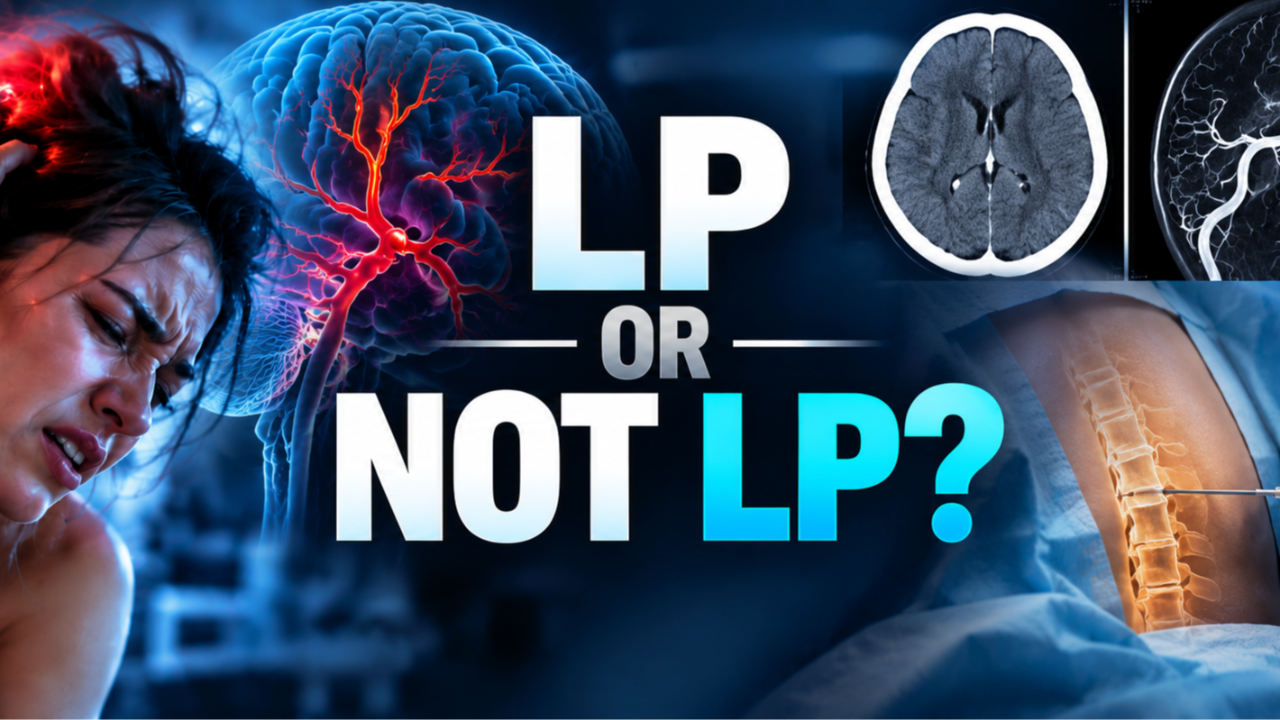
This publication is a letter responding to Voase et al., “To LP or not to LP?” (2025), which evaluated the diagnostic yield of lumbar puncture in patients presenting with acute severe headache and concluded that the very low yield of LP challenges the traditional practice of performing LP routinely in all patients with acute severe headache.
The letter challenges the interpretation of a low LP diagnostic yield and argues that abandoning or delaying LP may be premature.
In patients presenting with acute severe headache and a negative CT brain, is lumbar puncture still necessary?
We need to balance:
-
The risk of missing SAH or another serious intracranial diagnosis.
-
The relatively low diagnostic yield of LP in selected patients.
-
The complication rate post LP, including post-dural puncture headache and traumatic taps.
-
The consequences of false-positive or indeterminate CSF results.
-
The potential for unnecessary investigation and hospital admission.
The central argument of this correspondence is that low diagnostic yield does not necessarily mean low clinical value.
The original study
The authors discuss the service evaluation by Voase and colleagues, conducted using patients investigated between 2017 and 2021.
The original study reported a low yield of LP for detecting aneurysmal SAH requiring intervention.
-
Only one aneurysmal SAH requiring intervention was identified in the outcome emphasised by the original investigators.
-
Additional cases of confirmed or suspected non-aneurysmal SAH occurred.
-
Other diagnoses included intracranial infection, idiopathic intracranial hypertension and cerebral venous sinus thrombosis.
-
False-positive or indeterminate CSF bilirubin results complicated interpretation.
Five major criticisms raised by the authors
- Selection bias may explain the low LP yield, as patients selected for LP after clinical assessment. Higher-risk patients may already have been identified through other pathways. Therefore, the low observed diagnostic yield may reflect effective patient selection rather than poor LP performance.
- Timing of CT was not adequately characterised ie., was it done at <6 hours
- LP diagnoses more than aneurysmal SAH
- Clinical assessment affects the reliability of diagnostic pathways. The six-hour CT evidence relied on appropriately trained emergency clinicians assessing the initial presentation. The authors question whether those results can automatically be generalised to every clinical setting and level of practitioner experience.
- CT angiography is not equivalent to LP. CTA identifies vascular abnormalities, whereas LP can provide evidence of haemorrhage and other CSF abnormalities. Incidental aneurysms can create diagnostic uncertainty, unnecessary intervention and patient anxiety.
Other important diagnoses identified by LP
The correspondence emphasises that LP should not be considered exclusively a test for SAH.
|
Diagnosis
|
Potential LP findings
|
|
CNS infection
|
Pleocytosis, elevated protein, abnormal glucose, positive microbiology
|
|
Idiopathic intracranial hypertension
|
Elevated opening pressure, typically >25 cm CSF
|
| Spontaneous intracranial hypotension | Low opening pressure, sometimes
CT negative — what next?
Within 6 hours
A high-quality CT in an appropriately selected, neurologically intact patient may be sufficient to exclude SAH under applicable guidelines.
Beyond 6 hours or uncertainty persists
Consider further investigation, including LP or CTA, based on the clinical situation and local guidance.
SAH is not the only cause of dangerous headache. Consider infection, venous thrombosis, intracranial pressure disorders and other secondary causes.
The six-hour CT approach should not be applied indiscriminately. Its reliability depends on the patient population, scanner and interpretation quality, and the conditions under which the supporting evidence was obtained.
Does this paper change practice?
No — but it raises important concerns about overinterpreting studies reporting low LP yield.
The authors make a persuasive case for careful interpretation of observational data, particularly where selection bias, historical practice and incomplete diagnostic outcomes may affect the findings.
However, this letter does not provide sufficient evidence to recommend routine LP after every negative CT, nor does it invalidate carefully applied CT-based SAH exclusion pathways.
The most defensible conclusion is that further testing should be driven by residual clinical suspicion, the timing and quality of CT, and consideration of alternative diagnoses.