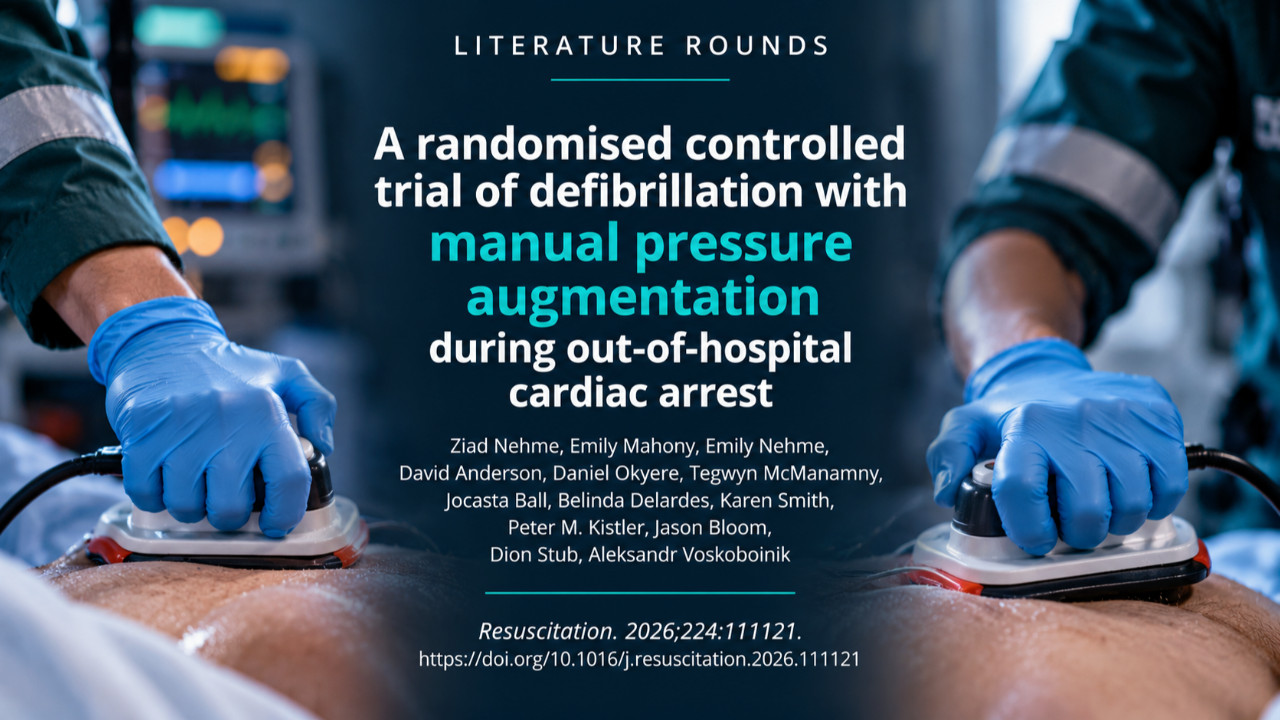
Manual pressure augmentation (MPA) during defibrillation significantly reduced transthoracic impedance but did not improve survival, successful defibrillation or neurological outcomes in patients with initially shockable out-of-hospital cardiac arrest.
However, the trial was terminated early and only 23.6% of eligible intervention patients received MPA according to protocol.
THE STUDY
Nehme Z, et al. Manual Pressure Augmentation During Defibrillation: Does It Improve Survival? The AUGMENT-VA Randomised Controlled Trial. Resuscitation. 2026;224:111121. DOI: 10.1016/j.resuscitation.2026.111121
Introduction
QUESTION ASKED: In adults with initially shockable out-of-hospital cardiac arrest, does manual pressure augmentation during defibrillation, compared with standard defibrillation, improve survival to hospital discharge?
Successful defibrillation depends on delivering sufficient electrical current through the myocardium. Transthoracic impedance (TTI) represents the resistance encountered by electrical current passing through the chest. Higher impedance can reduce the current delivered to the myocardium during defibrillation.
Manual pressure augmentation involves applying firm downward pressure over the defibrillation pads during shock delivery. This will theoretically decrease impedance and potentially increase defibrillation success rates.
MPA has previously been investigated for electrical cardioversion of atrial fibrillation, particularly in bariatric patients or following unsuccessful conventional cardioversion.
However, evidence that this technique improves outcomes during cardiac arrest has been limited.
The AUGMENT-VA trial was designed to determine whether reducing impedance during defibrillation translates into improved survival following cardiac arrest.
What they did
This was an Investigator-initiated, open-label, two-arm, cluster-randomised controlled trial across 216 ambulance stations in Australia.
N = 560 patients included in the primary intention-to-treat analysis.
Ambulance stations were randomised rather than individual patients. The allocation of the first arriving paramedic team determined the defibrillation strategy.
The study was open-label to paramedics, but patients and outcome assessors were blinded to treatment allocation.
Both groups received standard resuscitation care, with anterior–lateral defibrillation pad placement and biphasic shocks set at 200 J.
In the intervention group, paramedics were trained to apply approximately 10–15 kg of downward pressure directly over the defibrillation electrodes during shock delivery.
The safety protocol included double nitrile gloves, avoiding high-moisture environments, limiting hand contact to the electrodes and eliminating other contact with the patient or stretcher.
MPA was considered during each rhythm check when required, using a coordinated sequence intended to minimise interruptions to chest compressions.
What they found
Primary outcome: Survival to hospital discharge
SURVIVAL TO HOSPITAL DISCHARGE
39.8% (111 / 279) MPA vs 39.9% (112 / 281) Standard
There was no observed difference in survival between groups.
The absolute risk difference was −0.1 percentage points (95% CI −8.2 to +8.0 percentage points).
Importantly, the confidence interval is wide. The study cannot exclude a clinically meaningful benefit or harm from an effectively delivered intervention.
The following results are from the intention-to-treat analysis.
|
Outcome
|
MPA
|
Standard
|
| 12-month survival |
37.3% |
38.1% |
| Favourable neurological outcome at 12 months |
36.4% |
36.3% |
| Any prehospital ROSC |
68.5% |
70.8% |
| VF/VT termination after first shock |
58.2% |
55.7% |
| ROSC after first shock |
25.5% |
24.6% |
There were no statistically significant differences in these outcomes.
In particular, despite reducing impedance, MPA did not produce a demonstrated improvement in first-shock termination of VF/VT.
There was a significant reduction in median transthoracic impedance in the intention-to-treat population and in patients receiving MPA according to protocol.
MPA also increased median transthoracic current from 16.4 A to 17.4 A in the intention-to-treat population and to 18.2 A in the per-protocol intervention population.
However, the increase in current did not translate into a demonstrated improvement in clinical outcomes.
How many patients actually received MPA?
246
Intervention-group patients shocked by paramedics
78 (31.7%)
Received MPA at any time
58 (23.6%)
Received MPA according to protocol
Of the 279 intervention-group patients, 33 received shocks before paramedics arrived and were not shocked by paramedics.
Among the remaining 246 patients, only 58 received MPA according to protocol.
This means that approximately three-quarters of the patients who could have received MPA according to the intervention protocol did not receive it as intended.
The intention-to-treat analysis compares assignment to an MPA strategy with assignment to standard defibrillation. Because most intervention-group patients did not receive MPA according to protocol, the treatment contrast between the groups was substantially diluted.
Consequently, the study provides stronger evidence about the real-world implementation of an MPA strategy than about the biological efficacy of consistently applied MPA.
The per-protocol analysis also found no significant improvement in survival, but only 58 intervention patients were included in that analysis. It was therefore imprecise and cannot establish whether correctly delivered MPA improves survival.
Is it safe to apply pressure during defibrillation?
Reported perceptible shocks to rescuers: Events per 1,000 paramedic shocks delivered.
0.75 MPA group vs 0.71 Standard group
Five workplace safety incidents involving perceptible shocks were reported during the study period, including two involving patients in the intention-to-treat population.
The MPA-associated event occurred in a high-moisture environment. The control-group event involved inadvertent shock delivery while chest compressions were ongoing.
Neither event resulted in serious injury.
Interpretation: Serious rescuer injury was not observed, but the trial was not large enough to establish the safety of routine MPA, particularly when environmental conditions or adherence to the safety protocol are suboptimal.
Conclusion
This is a cluster-randomised design that used established registry infrastructure and included patient-centred outcomes, rather than relying solely on successful rhythm conversion.
The study was underpowered to exclude a clinically important treatment effect. The investigators planned to enrol 1,498 patients to detect an absolute 7.5-percentage-point difference in survival with 80% power. Only 560 patients were included in the primary analysis, approximately 37% of the planned sample.
The trial was stopped following safety-related interruptions and operational difficulties. The decision was made without unblinding outcome data.
Only 23.6% of intervention patients shocked by paramedics received MPA according to protocol, which limits the ability of the trial to determine the efficacy of MPA when delivered correctly.
The open-label design and potential implementation bias as paramedics were aware of treatment allocation. Although outcome assessors were blinded, provider behaviour and adherence could have been influenced by treatment assignment.
The cluster-randomised design also carries potential recruitment and identification bias.
My Take on This
This study does not provide evidence to support MPA as part of standard defibrillation protocols.
For refractory VF, MPA remains an intervention with a plausible physiological mechanism but uncertain clinical benefit, hoever we need further research in these areas in a study with high protocol adherence.