The Low Oxygen Intervention for Cardiac Arrest Injury Limitation (LOGICAL) trial
The current response to patients who have achieved ROSC post cardiac arrest, is to decrease concentrations of oxygen as rapidly as possible. In some animal models there is a signal that hyperoxia, past the first hour should be avoided.
Reperfusion with high oxygen concentrations may increase oxidative stress and neuronal injury. Aggressive oxygen restriction may cause hypoxaemia in an already injured brain. Previous trials have produced conflicting results, leaving the optimal post-ROSC oxygen target uncertain.
The LOGICAL trial asked whether a deliberately conservative oxygen strategy improves neurologically favourable survival compared with a more liberal strategy.
THE STUDY
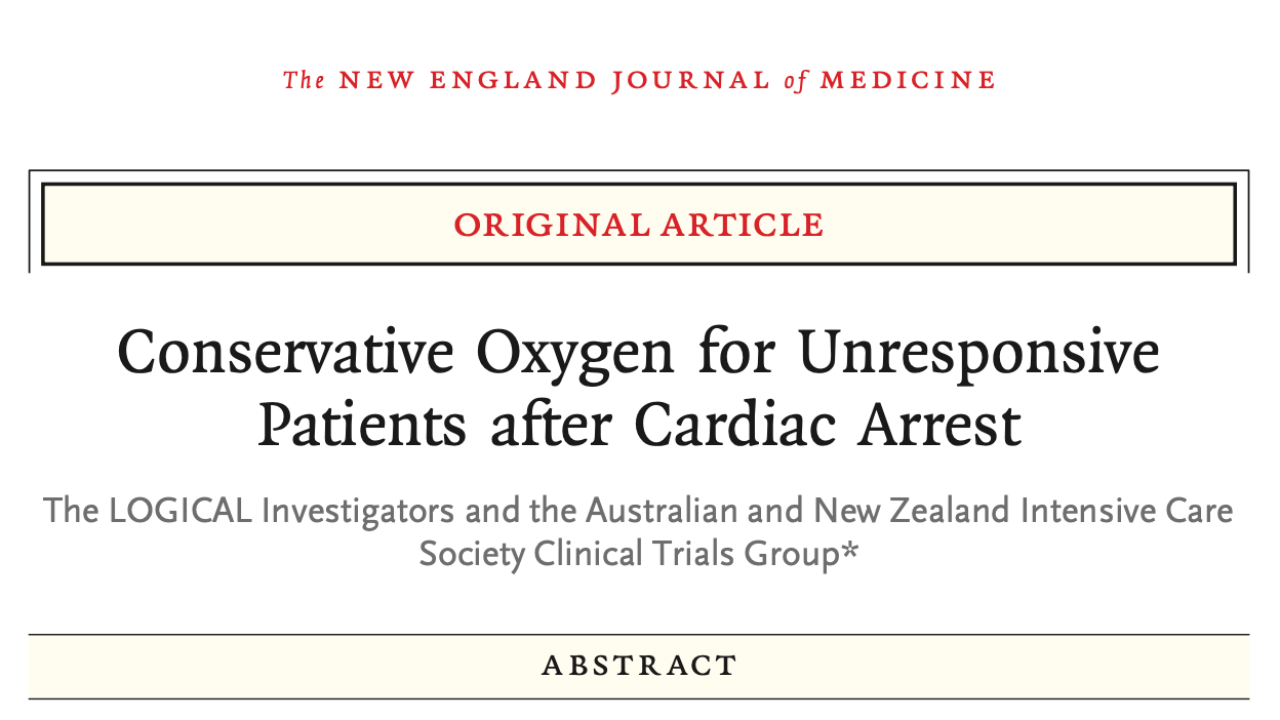
Conservative Oxygen for Unresponsive Patients after Cardiac Arrest.
New England Journal of Medicine. 2026;395:571–581. DOI: 10.1056/NEJMoa2513814.
| |
LOGICAL |
| Population |
Adults ≥18 years, mechanically ventilated in ICU after cardiac arrest, unable to follow commands after ROSC with suspected ischaemic encephalopathy |
| Intervention |
Conservative oxygen: SpO₂ lower alarm 90%, upper alarm 95%; FiO₂ reduced as low as 0.21 |
| Comparator |
Liberal oxygen: lower SpO₂ alarm 90%; no upper SpO₂ restriction; minimum FiO₂ 0.30 while mechanically ventilated |
| Outcome |
Primary: Survival with favourable functional outcome at 180 days: GOS-E ≥5
Secondary: all-cause and cause-specific mortality at 180 days, duration of survival to followup, quality of life, duration of mechanical ventilation, hospital LOS, discharge to home.
|
Patients had to be enrolled within 12 hours of meeting eligibility criteria. oxygen in cardiac arrest. The intervention actively reduced FiO₂ toward 21%, while the liberal group was prevented from going below FiO₂ 0.30 during ventilation. oxygen in cardiac arrest
What they did
This was an investigator-initiated, multicentre, parallel-group, open-label, assessor-blinded randomized trial nested within mega randomised registry trial research program Mega-ROX.
N = 1,840 adult patients from 53 ICUs in Australia, New Zealand and Ireland were randomized:
882 → conservative oxygen
958 → liberal oxygen
The intention-to-treat population ultimately contained 1,821 patients. oxygen in cardiac arrest
The population is representative of the ICU post-arrest population: mean age around 60 years, approximately three quarters had OHCA, around half had an initially shockable rhythm, and mean time to sustained ROSC was about 25–26 minutes. Importantly, randomization occurred relatively late: median ~7 hours after ROSC.
What They Found
Primary outcome
Alive with GOS-E 5–8 at 180 days occurred in 313 of 819 patients (38.2%) in the conservative-oxygen group and 353 of 890 patients (39.7%) in the liberal-oxygen group (adjusted absolute risk difference, −0.9 percentage points; 95% confidence interval [CI], −5.5 to 3.7; relative risk, 0.97; 95% CI, 0.87 to 1.09; P = 0.65)
Secondary Outcomes:
At day 180, 416 of 866 patients (48.0%) in the conservative-oxygen group and 469 of 943 patients (49.7%) in the liberal-oxygen group were alive (adjusted relative risk for death, 0.97; 95% CI, 0.88 to 1.06; adjusted hazard ratio, 0.96; 95% CI, 0.85 to 1.09)
The intervention did affect oxygen exposure
The strategies genuinely produced different oxygen exposures as seen below. One of the drawbacks of the conservative therapy was that reducing hyperoxia, also substantially increased the proportion experiencing at least one PaO₂ <60 mmHg: 43.4% vs 27.5%, RR 1.57. oxygen in cardiac arrest
| Oxygen exposure |
Conservative |
Liberal |
| Median % time SpO₂ ≥97% |
21.2% |
53.0% |
| Median hours SpO₂ ≥97% |
16 h |
37 h |
| ≥1 PaO₂ >100 mmHg |
57.7% |
78.4% |
| ≥1 PaO₂ <60 mmHg |
43.4% |
27.5% |
| Median hours FiO₂ 0.21 |
23 h |
0 h |
Conslusions
Primary endpoint: favourable neurological survival at 180 days
Conservative oxygen: 313/819 — 38.2%
Liberal oxygen: 353/890 — 39.7%
There was no evidence of benefit from conservative oxygen therapy.
Mortality
There was also no meaningful mortality difference:
Alive at 180 days
Conservative: 48.0% vs Liberal: 49.7% RR 0.97 (95% CI 0.88–1.06).
Quality of life, cognition, duration of ventilation, ICU stay, hospital stay and discharge home were also broadly similar.
There was no convincing subgroup suggesting a population that benefited from conservative oxygen.
The early-treatment question was looked at. Among patients randomized ≤4 hours after ROSC, there was no clear signal favouring conservative therapy.
Conclusion
This is a large pragmatic randomized trial answering a clinically important question with a patient-centred endpoint rather than a surrogate such as PaO₂.
The groups were well separated in oxygen exposure, outcome assessors were blinded, baseline characteristics were similar, the primary analysis was intention-to-treat, and follow-up extended to 180 days. It also recruited both OHCA and IHCA across 53 ICUs, making it more broadly applicable than some previous post-arrest oxygen studies.
The primary outcome data were available for approximately 94% of participants in both groups, which is reassuring for a six-month neurological outcome study.
Limitations and concerns
1. Median randomization occurred approximately 7 hours after ROSC.
If indeed hyperoxia-mediated reperfusion injury is most important in the minutes or first few hours following ROSC, this trial may have started the intervention after some of that injury had already occurred.
2. "Liberal" oxygen wasn't extreme hyperoxia
The Liberal group were not FiO₂ 1.0.
The liberal group simply had no upper SpO₂ restriction and had a minimum FiO₂ of 0.30 while ventilated. So the trial should not be interpreted as evidence that severe or prolonged hyperoxaemia is harmless.
3. Conservative oxygen increased episodes of low PaO₂
At least one PaO₂ <60 mmHg occurred in:
43.4% conservative vs 27.5% liberal.
Thus aggressively reducing oxygen exposure isn't physiologically neutral. Avoiding hyperoxia may come at the price of increasing episodes of hypoxaemia.
4. Protocol deviations
Failure to reduce FiO₂ appropriately occurred in 26.3% of conservative patients, while 8.4% of liberal patients received FiO₂ <0.30. This could have reduced separation between the strategies.
The authors acknowledge this, although sensitivity analyses excluding protocol deviations remained consistent with the primary analysis.
5. Open-label treatment
Clinicians knew the oxygen allocation, however outcome assessors were blinded.
My Take on This
Reducing oxygen exposure did not improve patient-centred outcomes.
And importantly, the conservative strategy produced more episodes of PaO₂ <60 mmHg.
LOGICAL provides strong evidence against routinely driving FiO₂ down toward 0.21 simply to minimize oxygen exposure in the unresponsive post-arrest ICU patient.
My approach is still the same:
- Correct hypoxaemia.
- Avoid unnecessary hyperoxia.
- Don't chase a deliberately low oxygen strategy in the hope of improving neurological recovery.
- Maintaining adequate oxygenation without creating hypoxaemia.
After ROSC, oxygen should be titrated — not aggressively restricted. LOGICAL shows that deliberately minimizing oxygen exposure does not improve 180-day neurological survival.