
In This Issue:
🫀 ECG of the Week: VT or SVT? What do you do next?
💔 Topic Review: Cardiogenic Shock — 40–50% mortality. What does the evidence say?
🚨 Case of the Week: A 68 yo collapses. BP won't come up. Your move.
📋 Lit Rounds: Choosing vasoactive agents in cardiogenic shock

EMCORE Melbourne
19-21st March 2027
We start with a 68 yo arriving with chest pain and APO. Sats are low and blood pressure is not recordable. What do you do next? This real time resuscitation is unveiled as we work on the patient on stage. As it unravels, we regroup to work out the best approach to take.
As the case is resolved you want to take a break, but not just yet.... A hypoxic, clammy patient, who can't take a breath is wheeled into resus.....
We then look at TRAUMA UPDATES and multiple HALO Procedures and then... the one month old that comes in shocked and the simple and ingenious pearls to help us resuscitate.
We look at arrhythmias, intubation pearls, ventilation pearls and Cardiology topics like SCAD, SADS, SCAPE and Syndrome X.
On the final day, vertebral dissections, Mimics and Chameleons, GBS Then tox, agitation, sedation, literature reviews and more.
3 days of total immersion:
RESUSCITATION | TRAUMA | HALO PROCEDURES | PAEDIATRICS |
AIRWAY | RESPIRATORY | CARDIOLOGY | NEUROLOGY |
LITERATURE ROUNDS
ECG of the Week:
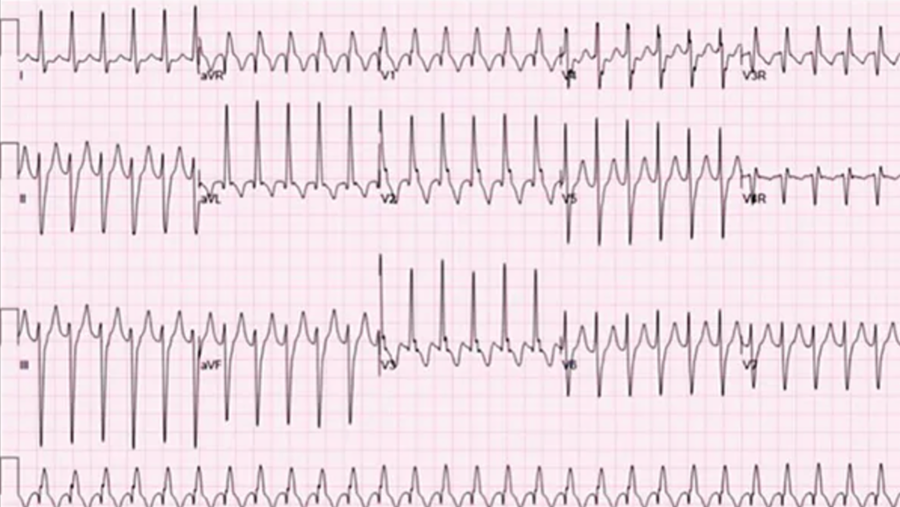
A Patient in his 40's presents with palpitations
He feels lethargic, but is haemodynamically stable. He has no significant past medical history.
His ECG is shown below. He is treated with escalating doses of Adenosine with no success. Metoprolol has no effect. He is DC cardioverted, however returns to the tachycardia again.
What does the ECG show and what is the diagnosis? Is it VT or SVT?
What do you do next?
Topic Review:
Cardiogenic Shock
It has a 40-50% mortality at 30 days. There are few evidence-proven strategies.
This is a summary of 15 RCT's. The review looks at:
- The approach to the diagnosis and treatment of Cardiogenic Shock
- Specific medications, procedure selection and assist device use.

EMCORE Singapore
14–16 April 2027
Talks, interactive sessions, debates, live resuscitations and more.
Three days of high-intensity Emergency Medicine education in one of Asia's most dynamic cities. Join clinicians from across the region for an experience that will sharpen your practice.
Literature Rounds
Vasoactive Agent Selection Strategies
THE STUDY
Erin A. Bohula and David A. Morrow. Circulation. 2026;154:775–784.
This was not a systematic review but a narrative review.
Practical Messages to take away:
1. Recognise shock despite normal BP. Tissue hypoperfusion is the defining feature, not hypotension alone.
2. Use noradrenaline as a reasonable default in undifferentiated hypotensive cardiogenic shock, while recognising that no agent has definitively established first-line superiority.
3. Consider adding an inodilator when MAP is restored but cardiac output remains inadequate, rather than simply escalating vasoconstriction.
4. Recognise RV-predominant shock early. Avoid unnecessary increases in PVR, consider vasopressin where appropriate, and tailor inotropic support.
5. Reassess repeatedly. MAP alone is not an adequate measure of successful resuscitation. Lactate trends, capillary refill, mental status, urine output, echocardiography and, where appropriate, invasive haemodynamics all contribute.
Read the full literature review
EM MASTERY CORE MEMBERSHIP


Responses