Cardiogenic Shock
Jul 31, 2026Cardiogenic shock is associated with a 30-day mortality of 40–50%. There are few therapies with proven mortality benefit and the approach should be directed according to the cause of shock ie., one treatment does not fit all.
The two treatments with the strongest evidence for improving survival are:
- Early coronary revascularisation for myocardial infarction-related cardiogenic shock and
- Microaxial flow pumps (Impella-type devices) in selected STEMI patients with severe left ventricular failure and low risk of hypoxic brain injury.
THE STUDY
Thiele, H Hassager, C. Cardiogenic Shock. NEJM 394;1 January 1 2026 pp 62-77
In this review we look at:
- The approach to the diagnosis and treatment of Cardiogenic Shock
- Specific medications, procedure selection and assist device use.
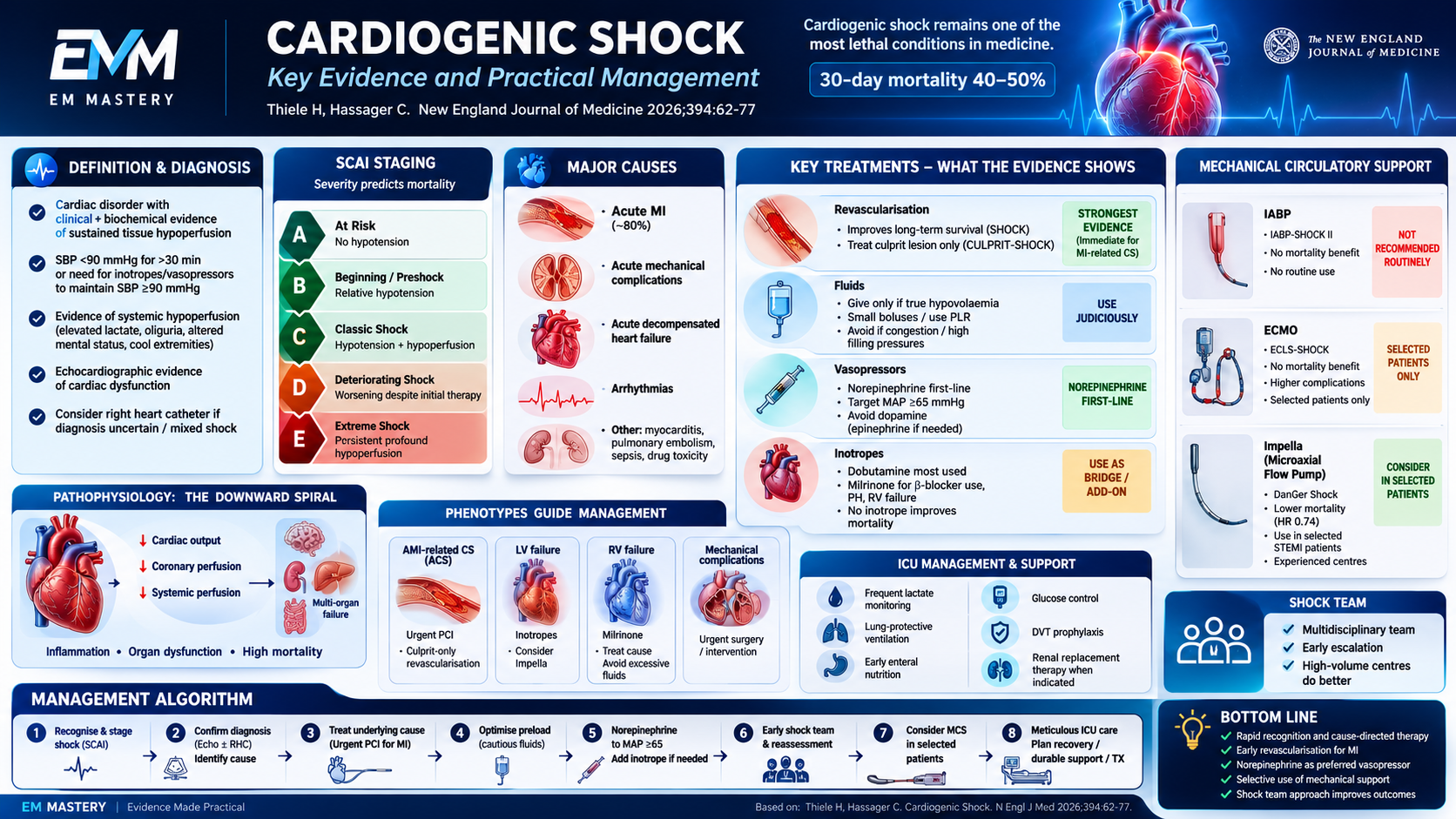
There is an infographic you can down load at the end of the article that summarises it all.
This was a narrative review, that looked at 15 RCTs.
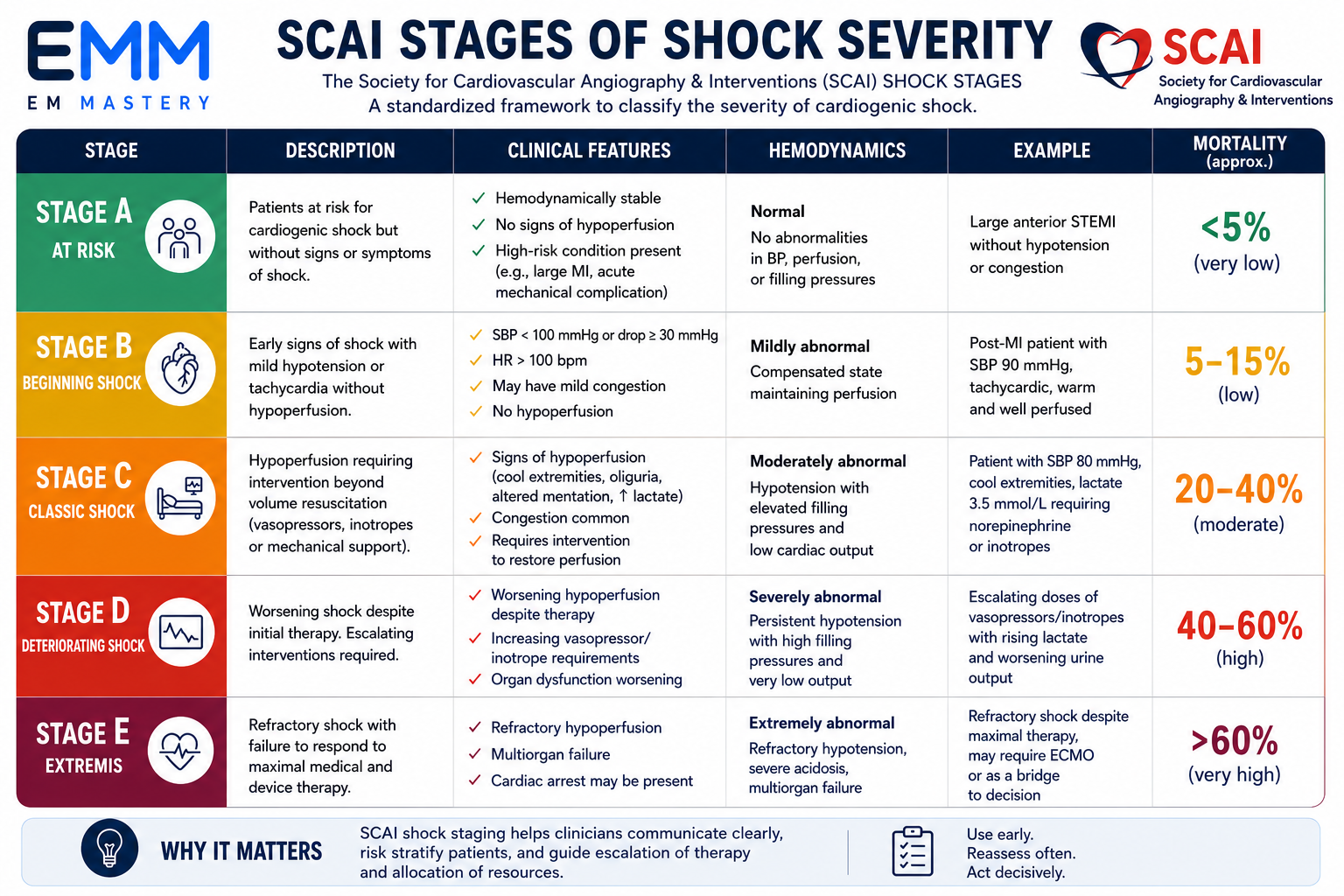
They reviewed the SHARC (1) consensus definition (SBP <90 mmHg >30 min or need for vasoactive support to maintain SBP ≥90, plus hypoperfusion) and the SCAI (2) 5-stage system (A–E: at risk → extremis), which grades severity using lactate, ALT, pH, and treatment intensity.
They found that staging correlates with mortality at a population level but does not apply to individual prognosis, as comparisons across studies are hampered by subjectivity and the use of inconsistent shock definitions.
The study makes the obvious comment, that taking patients to specialised tertiary care centres that treat a lot of cardiogenic shock patients and can escalate to mechanical circulatory support, is associated with lower mortality.
The authors also recommend multidisciplinary shock teams, which could include:
- interventional cardiology
- ICU
- heart failure specialists
- cardiothoracic surgery
- perfusionists
The management strategy in summary, is shown below. We then look at more detail at the various recommendations, which are critical to understand.
One of the most important distinctions in this review article is that it does not advocate one treatment for all.
AN APPROACH
- Recognise cardiogenic shock and classify severity using the SCAI stages (shown below).
- Confirm the diagnosis with echocardiography
- Assess haemodynamics if uncertainty exists.
- Identify and treat the underlying cause (especially urgent PCI for acute MI-related shock).
- Optimise preload with cautious fluids only if hypovolaemic; avoid fluid overload.
- Use norepinephrine(noradrenaline) as the first-line vasopressor to maintain perfusion (typically aiming for MAP ≥65 mmHg), adding dobutamine or another inotrope if cardiac output remains inadequate(more on this below).
- Consider mechanical circulatory support only in carefully selected patients, balancing potential benefits against device-related complications.
- Routine use of IABP or ECMO has not demonstrated a survival benefit in unselected patients
- Impella (microaxial flow pumps) may improve survival in a group with STEMI-related, left ventricular–dominant shock
- Provide meticulous ICU supportive care while planning recovery, durable mechanical support, or transplantation where appropriate.
SCAI Severity Index
Below are the treatment strategies discussed:
REVASCULARISATION
This is the highest priority in myocardial cause of shock.
The SHOCK trial demonstrated that although there was no significant 30-day mortality reduction, early revascularisation reduced mortality at up to 6 years.
The CULPRIT-SHOCK trial culprit-lesion-only PCI reduced death/renal-replacement-therapy vs. immediate multivessel PCI (45.9% vs 55.4%, RR 0.83). The goal was to treat only the culprit lesion initially,voiding multi-vessel PCI. This resulted in:
- shorter procedures
- less contrast
- lower renal injury
- improved survival
Staged revascularization recommended afterward, with non-culprit leasions treated at this time.
FLUIDS
Not every hypotensive patient requires fluids.
- true hypovolaemia,
- with no pulmonary congestion and
- where passive leg raise improves haemodynamics.
VASOPRESSORS
NOREPINEPHRINE(NORADRENALINE)
The review strongly supports norepinephrine(noradrenaline) as first-line vasopressor to aim at a MAP of 65 mmHg.Advantages include:
- raises MAP
- fewer arrhythmias
- fewer metabolic complications
- better safety profile
EPINEPHRINE(ADRENALINE)
Epinephrine(adrenaline), is not a first line recommendation. It increases cardiac output, however also has some unwanted side effects causing:
- tachycardia
- increased lactate
- metabolic acidosis
- greater myocardial oxygen demand
DOPAMINE
Avoid as it gives no survival advantage and results in significantly more arrhythmias.
VASOPRESSIN
Studies for its use in cardiogenic shock are lacking.
INOTROPES
Inotropes are a bridging therapy, improve contractility but not necessarily mortality. The lowest effective dose must be used as they increase myocardial oxygen consumption and the rate of arrhythmias.
In the shocked patient if noradrenaline does not improve cardiac output then we can add an inotrope such as:
DOBUTAMINE
This is the most commonly used inotrope for:
- Low cardiac output states
- Even if blood pressure is adequate
- In left ventricular failure.
MILRINONE
There is no mortality difference between this and dobutamine.
Use in:
- patients on beta blockers
- if pulmonary hypertension
- if right ventricular dysfunction
LEVOSIMENDAN
It is not recommended for routine use.
It provides:
- Calcium sensitisation
- positive inotropy
- vasodilatation
MECHANICAL CIRCULATORY SUPPORT
INTRAAORTIC BALLOON PUMP (IABP)
IABP-SHOCK II (3)(AMI-related shock) and Altshock-2 (4) (HF-related shock), both vs. medical therapy/no IABP, showed no survival benefit in either population. There is no mortality benefit and it does not improve cardiac output. Routine IABP use is not recommended in AMI-shock.
Potential mechanical complications where it may still be used include:
- acute mitral regurgitation
- VSD
- a bridge to surgery
VENOARTERIAL ECMO
ECLS-SHOCK trial (routine early VA-ECMO vs. standard care in severe AMI-shock) plus a 4-trial individual-patient meta-analysis.
There was no mortality difference (47.8% vs 49.0% at 30 days; sustained at 1 year), more complications (including bleeding, limb ischaemia, stroke) with ECMO. A separate trial of left-ventricular unloading (transseptal cannula) added to ECMO also showed no mortality benefit.
It is not recommended for routine use. It may be considered in specific cases including:
- severe refractory shock
- reversible pathology
- bridge to transplant
- bridge to LVAD
MICROAXIAL FLOW PUMP(IMPELLA-TYPE)
The DanGer Shock trial (5) included 360 STEMI patients with LV-dominant shock, excluding those at risk of hypoxic brain injury; pump vs. standard care (no pump).
They found a lower 180-day mortality (HR 0.74, 95% CI 0.55–0.99), benefit sustained to 10 years — but there we me complications in the form of more bleeding, limb ischemia, and renal-replacement therapy.
Only ~5–32% of real-world shock patients meet DanGer Shock eligibility criteria.
In large propensity-matched registries (>100,000 patients) no benefit has been shown. Patient selection is crucial here.
It is not recommended for use in every patient, however it should be considered for patients with:
- STEMI
- profound LV failure
- low risk of severe hypoxic brain injury
- experienced centre
- shock team available
SUMMARY OF TREATMENT BASED ON AETIOLOGY
AMI-STEMI, no cardiac arrest, LV-dominant, low hypoxic-brain-injury risk (<10% of all shock)
- First line approach: Emergency culprit-lesion-only PCI + staged revascularization later
- Mechanical support: Routine microaxial flow pump has a mortality benefit in this selected group
AMI (STEMI/NSTEMI) with cardiac arrest (~50% of AMI shock)
- First line approach: Emergency culprit-lesion-only PCI + staged revascularization later
- Mechanical support: Avoid routine microaxial flow pump use, as no benefit, more harm.
Mechanical complication (rupture, papillary muscle, VSD) (~3%)
- First line approach: Surgical/percutaneous repair
- Mechanical support: Microaxial flow pump as a bridge to surgery, in selected patients.
Heart failure–related shock (>50% of all shock, mostly acute-on-chronic)
- First line approach: Heart failure related care; vasopressor = norepinephrine; inotrope choice per local practice (no proven winner)
- Mechanical support: Only in selected patients being bridged to LVAD/transplant; IABP not proven (Altshock-2)
Secondary shock (non-cardiac trigger, <10%)
- First line approach: Treat cause
- Mechanical support: Only in selected patients.
PULMONARY ARTERY CATHETERS
The authors support pulmonary artery catheters in selected patients who do not have an adequate response to intital therapy or in diagnostic or therapeutic uncertainty.
These may be seful when:
- diagnosis uncertain
- mixed shock
- RV failure
- escalating therapy
- mechanical support decisions
INFOGRAPHIC FOR YOU TO DOWNLOAD
JOIN LITERATURE ROUNDS at only $1/week
REFERENCES
- Waksman R, et al. Standardized definitions for cardiogenic shock research and mechanical circulatory support devices: scientific expert panel from the Shock Academic Research Consortium (SHARC). Circulation 2023; 148: 1113-26.
-
Naidu SS, et al. SCAI SHOCK stage classification expert consensus update: a review and incorporation of validation studies. J Am Coll Cardiol 2022; 79: 933-46.
-
Thiele H, et al. Intraaortic balloon pump in cardiogenic shock complicating acute myocardial infarction: long-term 6-year outcome of the randomized IABP-SHOCK II trial.Circulation 2019; 139: 395-403.
-
Morici N, et al. Early intra-aortic balloon support for heart failure-related cardiogenic shock: a randomized clinical trial. J Am Coll Cardiol 2025; 85: 1587-97.
-
Møller JE, et al. Microaxial flow pump or standard care in infarct-related cardiogenic shock. N Engl J Med 2024; 390: 1382-93
Join Our Free email updates
Get breaking news articles right in your inbox. Never miss a new article.
We hate SPAM. We will never sell your information, for any reason.