A stroke mimic is a conditions that can present with neurological symptoms and looks like a stroke but isn't. Common causes of mimics include: Seizures, migraines, hypoglycaemia, sepsis, and peripheral vestibular disorders, just to name a few. The rate of mimics is between 20-30%, which is quite high(1)
A stroke Chameleon is a stroke masquerading as something else.
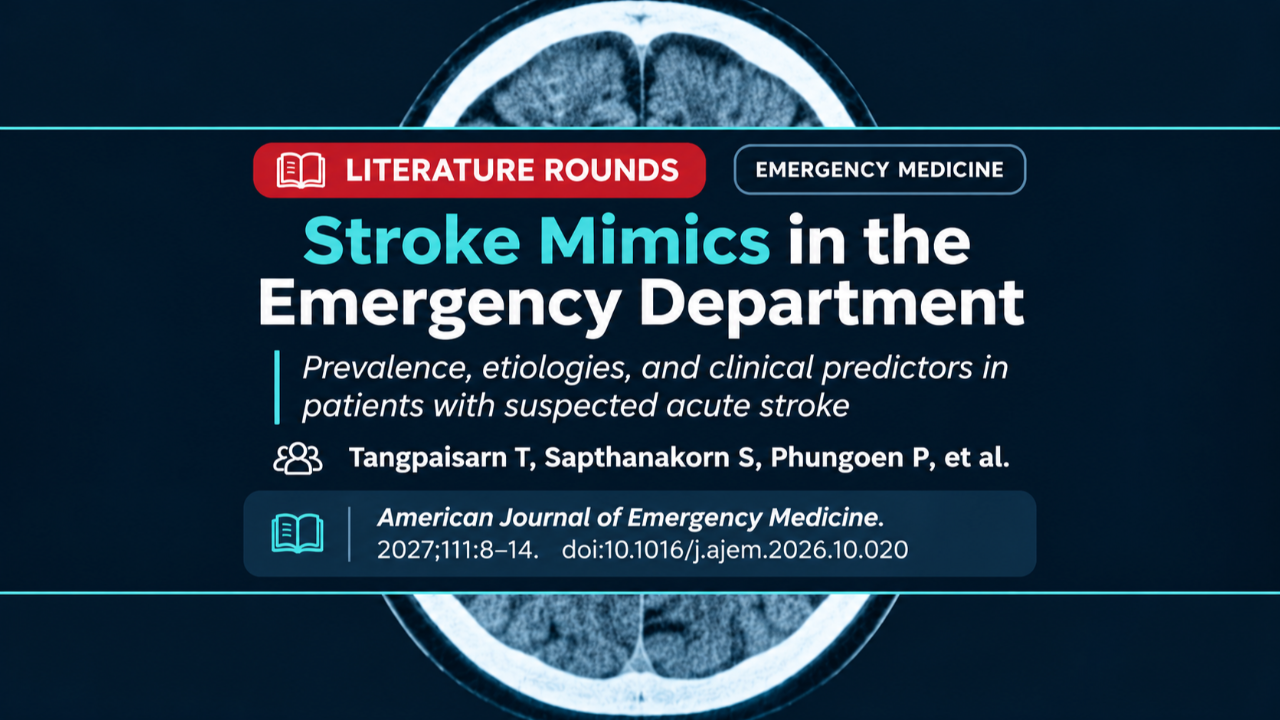
A recent retrospective cohort study, examined 1,615 patients presenting through an acute stroke pathway at a tertiary hospital in Thailand, within 9 hours of symptoms, to determine the rate of presentation of stroke mimics. They found that 21.5% of presentations were stroke mimics, of which seizures(13.8%), altered consciousness, vertigo and fever were the most common causes (2). Limb weakness and speech disturbance were associated with genuine cerebrovascular events. The confirmed-stroke group included ischaemic stroke, intracerebral haemorrhage, subarachnoid haemorrhage and TIA.
The investigators sought to establish:
-
The prevalence of stroke mimics in adult patients presenting with suspected acute stroke.
-
The most common underlying diagnoses.
-
Which presenting clinical characteristics independently predicted stroke mimics rather than true stroke.
14 diagnostic categories were identified among the 347 patients with stroke mimics.
Most common stroke mimic categories included:
Smaller categories, including non-CNS neoplasms, toxicological and traumatic conditions, are omitted from the above chart.
Several observations are clinically important:
Seizures:The most common individual category was seizure-related disorders, which is consistent with previous studies and accounting for 48 patients (13.8% of mimics). A postictal neurological deficit is an important stroke mimic. However, seizure can also occur at the onset of a genuine stroke.
Vestibular presentations: Peripheral vestibular conditions accounted for 9.2% of mimics, but the study does not establish that vertigo is a reliable discriminator between central and peripheral causes.
Infection: Infectious and inflammatory diagnoses accounted for 10.1% of mimics. These include conditions requiring urgent treatment in their own right.
Functional neurological disorders: These accounted for only 3.5% of mimics, substantially fewer than seizure-related and systemic conditions.
Which clinical features predict a stroke mimic?
The most useful part of this paper is its multivariable analysis.
Presenting features associated with stroke mimics
Adjusted odds ratios for stroke mimic diagnosis
Values above 1 indicate higher odds of a mimic. Adjusted associations, not diagnostic likelihood ratios.
Source: Table 4 (2)
| Presenting feature |
Adjusted OR (95% CI) |
P-value |
| Fever |
3.10 (1.36–7.12) |
0.007 |
| Seizure |
2.68 (1.79–4.00) |
<0.001 |
| Vertigo |
1.85 (1.28–2.65) |
<0.001 |
| Altered consciousness |
1.71 (1.25–2.33) |
<0.001 |
| Speech disturbance |
0.65 (0.45–0.94) |
0.022 |
| Limb weakness |
0.31 (0.20–0.47) |
<0.001 |
Interpretation of Clinical Predictors
Fever had the strongest positive association with stroke mimics, although only 30 patients presented with fever. The confidence interval is wide, reflecting limited precision.
Limb weakness was the strongest negative predictor. Its adjusted OR of 0.31 represents 69% lower adjusted odds of a mimic in patients reporting weakness, not a 69% reduction in the probability of a mimic.
Speech disturbance was also associated with confirmed stroke, but importantly, it was still present in 64% of patients with mimics.
These are group-level associations, not reliable standalone diagnostic tests.
| Predictor |
Adjusted OR |
Interpretation |
| History of migraine |
2.88 |
Higher odds of mimic |
| History of epilepsy |
2.29 |
Higher odds of mimic |
| Psychiatric disorder |
2.15 |
Higher odds of mimic |
| Atrial fibrillation |
0.62 |
Lower odds of mimic |
| Male sex |
0.75 |
Lower odds of mimic |
Age, diastolic blood pressure and heart rate were statistically associated with mimic diagnosis, but their per-unit effect sizes were small.
A particularly interesting finding was that systolic blood pressure, although higher in confirmed stroke patients, was not independently significant after adjustment.
Important clinical caution: A psychiatric history should never be used to dismiss a new neurological deficit as functional. The study demonstrates an association, not a method of diagnosing functional neurological disorder.
Study appraisal
Strengths
The study has several useful features.
-
A reasonably large cohort of 1,615 consecutive eligible stroke-pathway patients over four years.
-
Real-world ED presentations, rather than an artificially selected research population.
-
Final diagnostic classification undertaken by neurologists.
-
Adjustment for multiple clinical variables.
-
A clinically relevant emphasis on symptoms available during initial triage.
-
A detailed description of mimic etiologies, rather than treating all mimics as a single diagnosis.
Limitations
1. Selection bias
Of 1,694 patients entering the stroke pathway, 72 were excluded following early pathway discontinuation, and another seven because of incomplete data.
Patients with obvious alternative diagnoses may therefore have been excluded. The reported 21.5% mimic prevalence applies to the selected stroke-pathway population, not all ED patients with neurological symptoms.
2. Retrospective design
Clinical symptoms were obtained from documentation rather than standardised prospective assessment. Differences in documentation could influence the associations.
3. No validated diagnostic prediction model
The authors report adjusted odds ratios, but do not provide a validated bedside score, sensitivity, specificity, calibration or discrimination statistics for their combined model.
Consequently, the results cannot tell us whether a particular patient can safely be classified as a mimic.
4. Potential diagnostic misclassification
The final diagnosis was determined by neurologists during the index admission, without standardised long-term follow-up.
This could miss some initially unrecognised cerebrovascular events.
5. Limited stroke severity information
NIHSS scores and vascular imaging findings were not consistently available. This is important because stroke severity and vascular territory may influence presenting symptoms.
6. Limited generalisability
The study was performed in one tertiary Thai hospital. The results may differ in Australian metropolitan and regional EDs, especially where access to MRI, stroke specialists and thrombectomy services varies.
Thrombolysis in stroke mimics
Three of the 347 patients with stroke mimics (0.9%) received intravenous thrombolysis.
Their final diagnoses were:
-
-
Cervical spinal cord injury.
-
This is an important clinical observation. Even with an organised stroke pathway and neurologist involvement, diagnostic uncertainty persists.
However, the paper does not provide sufficient outcome data for these three patients to establish the safety or harm of thrombolysis in this subgroup.
9. What should we do differently in the emergency department?
My interpretation is that this is a useful diagnostic-awareness paper rather than a practice-changing trial.
It supports several practical principles.
Maintain a broad differential diagnosis. Seizures, infections, metabolic disturbances and vestibular disorders are important causes of acute stroke-like presentations.
Recognise focal deficits. Limb weakness and speech disturbance strongly favoured cerebrovascular disease in this cohort, although both also occurred in mimics.
Do not use seizure to exclude stroke. Seizure at onset can accompany a genuine acute cerebrovascular event.
Be particularly careful with vertigo. Vertigo was associated with mimics, but 138 of the 196 patients presenting with vertigo had a confirmed cerebrovascular diagnosis. This study does not justify downgrading suspected posterior circulation stroke.
Do not delay urgent stroke assessment to establish a mimic diagnosis. The study has not demonstrated that its clinical predictors can safely alter reperfusion eligibility or imaging pathways.
10. Final Literature Rounds verdict
Potential to change practice
Editorial assessment, not a validated study-quality scoring system.
The study confirms that stroke mimics are common and heterogeneous, affecting approximately one in five patients assessed through this particular stroke pathway.
The most important limitation is the absence of a validated diagnostic strategy that can distinguish mimics from stroke safely enough to change acute management.
For EM Mastery Literature Rounds, I would emphasise one central teaching message:
Clinical features can change our suspicion of a stroke mimic, but they cannot safely exclude an acute stroke.
Suggested newsletter summary
Stroke Mimics: Can We Recognise Them Earlier?
A new study in the American Journal of Emergency Medicine examined 1,615 patients presenting with suspected acute stroke. Interestingly, 21.5% were ultimately diagnosed with a stroke mimic.
Seizures were the most common mimic diagnosis. Fever, seizures, altered consciousness and vertigo were associated with mimics, while limb weakness and speech disturbance favoured genuine stroke.
The important message? Although certain clinical findings increase the likelihood of a stroke mimic, none can reliably exclude stroke.
Read the paper: https://doi.org/10.1016/j.ajem.2026.10.020
For a full teaching session, the most valuable discussion would be whether these predictors actually improve ED decision-making, and how the results should be interpreted in patients with seizures, vertigo and posterior circulation symptoms.
References
- Gargalas S, et al. Incidence and outcome of functional stroke mimics admitted to a hyperacute stroke unit. J Neurol Neurosurg Psychiatry. 2017;88(1):2–6.
- Tangpaisarn T, et al. Stroke mimics in the emergency department: Prevalence, etiologies, and clinical predictors in patients with suspected acute stroke. American Journal of Emergency Medicine. 2027;111:8–14. Accepted 18 October 2026. DOI: 10.1016/j.ajem.2026.10.020